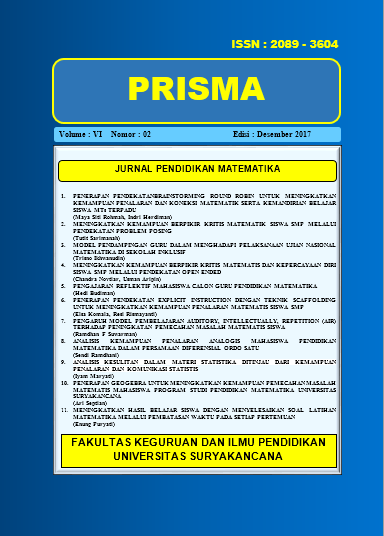
PENGAJARAN REFLEKTIF MAHASISWA CALON GURU PENDIDIKAN MATEMATIKA
DOI:
https://doi.org/10.35194/jp.v6i2.63Abstrak
Program Praktek Lapangan (PPL) merupakan sarana untuk menerapkan kemampuan yang sudah diperoleh mahasiswa calon guru secara teoritis di bangku kuliah. Selain kemampuan dalam penguasaan materi, mahasiswa calon guru juga dituntut dalam kemampuan berkomunikasi dan berinteraksi yang baik ketika mengajar siswa di kelas. Kegiatan PPL ini merupakan pelatihan untuk menjadi guru profesional, karena di dalamnya terkait sejumlah kemampuan pengajar yang professional. Idealisme yang diharapkan terhadap mahasiswa calon guru ini perlu didampingi dengan pengontrolan pada pelaksanaan dan pengkajian setelah pelaksanaannya. Salah satu upaya yang dilakukan terhadap proses pengajaran yang sudah dilakukan yaitu dengan observasi dan refleksi. Pengajaran reflektif seorang calon guru atau guru professional, berkaitan dengan kemampuan dan disposisi berpikir reflektif. Hasil penelitian menunjukkan bahwa para mahasiswa calon guru matematika ini pada umumnya sudah menunjukkan kemampuan reflektif dalam hal openmindness (keterbukaan), responsibility (tanggungjawab), wholeheartedness (kesungguhan dalam bertindak) untuk meningkatkan pengajaran di kelas. Kemampuan ini sangat bermanfaat dan perlu ditingkatkan ketika sudah menjadi guru kelas.
Referensi
Ash, S. L., & Clayton, P. H. (2004). The articulated learning: An approach to guided reflection and assessment. Innovative Higher Education, 29(2), 137-154.
Bright, B. (1996). Reflecting on Reflective Practice. Studies in the Education of Adults. Vol.28. No. 2 :162-184.
Budiman, H. (2014). Pengaruh Kecerdasan Emosional dan Kecemasan Matematika terhadap Kemandirian Belajar Siswa. FKIP UNSUR: Tidak diterbitkan.
Bullough, R., & Pinnegar, S. (2001). Guidelines for quality in autobiographical forms of self-study research. Educational Researcher, 30(3), 13-21.
Dewey, J. (1991). How We Think. (Rev. ed.). Boston: D. C. Heath.
Dinkelman, T. (2000). An Inquiry Into The Development of Critical Reflection in Secondary Student Teachers. Teaching and Teacher Education, 16(2).
Dohn, N. B. (2011). On the epistemological presuppositions of reflective activities. Educational Theory, 61(6).
Fraenkel, J.R dan Wellen, N.E. (2012). How to Design and Evaluate Research in Education. New York: McGraw-Hill.
Korthagen, F. A. J. (2001) Linking Practice and Theory: The Pedagogy of Realistic Teacher Education. Mahawah, NJ: Lawrence Erlbaum Associates
Laboskey, V.K. (1994). Development of Reflective Practice: a study of preservice teachers. New York: Teachers College Press.
Pereira, F. (2011). In-service teacher education and scholar innovation: The semantics of action and reflection on action as a mediation device. Australian Journal of Teacher Education, 36(11).
Takona, J. P. (2002). Pre-service Teacher Portfolio Development. Lincoln, NE: Writers Club Press.
Valli, L. (1997). Listening to other voices: A description of teacher reflection in the United States. Peabody journal of Education, 72 (1), 67-88
Zeichner, K. M., & Liston, D. P. (1996). Reflective Teaching: An Introduction. Mahwah, NJ: Lawrence Erlbaum Associates, Inc.
Unduhan
Diterbitkan
Terbitan
Bagian
Lisensi
As a journal Author, you have rights for a large range of uses of your article, including use by your employing institute or company. These Author rights can be exercised without the need to obtain specific permission.
Authors and readers can copy and redistribute the material in any medium or format, as well as remix, transform, and build upon the material for any purpose, even commercially, but they must give appropriate credit (cite to the article or content), provide a link to the license, and indicate if changes were made. If you remix, transform, or build upon the material, you must distribute your contributions under the same license as the original.
The Authors submitting a manuscript do so on the understanding that if accepted for publication, copyright of the article shall be assigned to PRISMA as publisher of the journal.

PRISMA by UNIVERSITAS SURYAKANCANA is licensed under a Creative Commons Attribution-ShareAlike 4.0 International License.
Based on a work at https://jurnal.unsur.ac.id/prisma.