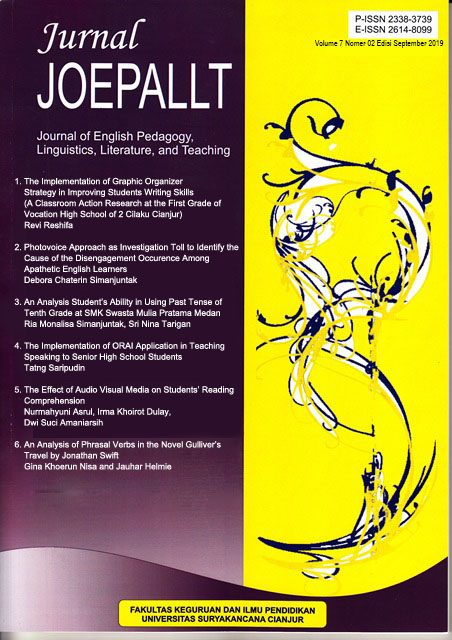
PHOTOVOICE APPROACH AS INVESTIGATION TOOL TO IDENTIFY THE CAUSE OF DISENGAGEMENT OCCURRENCE AMONG APATHETIC ENGLISH LEARNERS
DOI:
https://doi.org/10.35194/jj.v8i1.843Abstract
Student disengagement is an ongoing challenge in college education phenomena. Henceforth, this present article aims to identify the cause of disengagement among apathetic English learners. This study utilized descriptive qualitative research focusing on Photovoice approach, using camera as an investigation tool to identify the causes; it is a methodology that can be adapted to a variety of topics especially for educational setting. Research participants were chosen through purposive sampling; they were asked to take photographs and share their voices on photos they took to represent their current reasons of disengagement. The researcher analyzed the digital images and the accompanying narratives for themes to emerge. Through the analysis process, two main themes emerged from this study regarding reported sources which cause them to disengage form learning. They are: Negative Self-concept and Language Intricacy. The theme of Negative Self-concept contains two categories with four to five labels in each category. Meanwhile the theme of Language Intricacy contains three categories and each category has four labels. With regard to empower the apathetic learners, a theme occurred in the findings which is activity-based program. This theme has two categories and each category has four to five labelsuReferences
Abukhattala, I. (2013). Krashen’s five proposals on language learning: Are they valid in Libyan EFL classes. English Language Teaching, 6(1), 128–131. https://doi.org/10.5539/elt.v6n1p128
Almaguer, I., & Esquierdo, J. J. (2013). Cultivating bilingual learners’ language arts knowledge: A framework for successful teaching. International Journal of Instruction, 6(2), 3–18.
Alrajhi, M. N., & Aldhafri, S. S. (2015). Peer Tutoring Effects on Omani Students ’ English Self-Concept. 8(6), 184–193. https://doi.org/10.5539/ies.v8n6p184
Amengual-Pizarro, M. (2018). Foreign language classroom anxiety among English for Specific Purposes (ESP) students. International Journal of English Studies, 18(2), 145–159. https://doi.org/10.6018/ijes/2018/2/323311
Anwar, F. (2019). Activity-Based Teaching, Student Motivation and Academic Achievement. Journal of Education and Educational Development, 6(1), 154–170. https://doi.org/10.22555/joeed.v6i1.1782
Arung, F., Rafli, Z., & Dewanti, R. (2020). I Prefer My Own Ways to Acquire My English Speaking Skills : A Grounded Research. International Journal of Higher Education, 9(1), 32–43. https://doi.org/10.5430/ijhe.v9n1p32
Bankole Adeyemi, F. (2019). Peer group influence on academic performance of undergraduate students in Babcock University, Ogun State. African Educational Research Journal, 7(2), 81–87. https://doi.org/10.30918/aerj.72.19.010
Behrens, S. J., Chirinos, Y., Spencer, M., & Spradley, S. (2016). Academic English and Language-Related Technology. NADE Digest, 8(1), 28–34. Retrieved from https://stanford.idm.oclc.org/login?url=https://search.ebscohost.com/login.aspx?direct=true&db=eric&AN=EJ1178209&site=ehost-live&scope=site
Boonchuayrod, P., & Getkham, K. (2019). Investigating EFL Achievement Through the Lens of Demotivation. English Language Teaching, 12(6), 180. https://doi.org/10.5539/elt.v12n6p180
Çelik, Ö., & Kocaman, O. (2016). Barriers Experienced by Middle School Students in the process of Learning English. International Journal of Psychology and Educational Studies, 3(1), 33–48. https://doi.org/10.17220/ijpes.2016.01.003
Cendon, E. (2018). Lifelong learning at universities: Future perspectives for teaching and learning. Journal of New Approaches in Educational Research, 7(2), 81–87. https://doi.org/10.7821/naer.2018.7.320
Chipchase, L., Davidson, M., Blackstock, F., Bye, R., Colthier, P., Krupp, N., … Williams, M. (2017). Conceptualising and Measuring Student Disengagement in Higher Education: A Synthesis of the Literature. International Journal of Higher Education, 6(2), 31. https://doi.org/10.5430/ijhe.v6n2p31
Cook, K., & Quigley, C. (2013). Connecting to our community: Utilizing photovoice as a pedagogical tool to connect college students to science. International Journal of Environmental and Science Education, 8(2), 339–357. https://doi.org/10.12973/ijese.2013.205a
Dai, Z. (2015). The Concept of “English Learning Power” and Its Implication for the Design of English Curricula for Primary and Middle Schools in China. Journal of Education and Practice, 6(36), 128–133.
Dedonno, M. A., & Rivera-Torres, K. (2018). The influence of perfectionism on academic self-concept. International Journal of Education and Practice, 6(4), 192–199. https://doi.org/10.18488/journal.61.2018.64.192.199
Elsaid Mohammed, A. S., & Nur, H. S. M. (2018). Needs Analysis in English for Academic Purposes: The Case of Teaching Assistants at the University of Khartoum. How, 25(2), 49–68. https://doi.org/10.19183/how.25.2.409
Errey, R., & Wood, G. (2011). Lessons from a Student Engagement Pilot Study: Benefits for Students and Academics. Australian Universities’ Review, 53(1), 21–34.
Farley, L. A., Brooks, K., & Pope, K. (2017). Engaging Students in Praxis Using Photo voice Research. Multicultural Education, 24(2), 49–52. Retrieved from https://login.ezproxy.utas.edu.au/login?url=http://search.ebscohost.com/login.aspx?direct=true&db=eue&AN=124346256&site=eds-live
Gebauer, R. (2019). The Critical Nature of Intentionality When Supporting Academically Underprepared Students Through Learning Communities. Learning Communities Research and Practice, 7(1), 6–6.
Glaw, X., Inder, K., Kable, A., & Hazelton, M. (2017). Visual Methodologies in Qualitative Research: Autophotography and Photo Elicitation Applied to Mental Health Research. International Journal of Qualitative Methods, 16(1), 1–8. https://doi.org/10.1177/1609406917748215
Graziano, K. J. (2011). Working with english language learners: Preservice Teachers and Photovoice. International Journal of Multicultural Education, 13(1), 1–19. https://doi.org/10.18251/ijme.v13i1.354
Gürsoy, E., & Eken, E. (2018). English teachers’ understanding of the new English language teaching program and their classroom implementations. Journal of Language and Linguistic Studies, 14(2), 18–33.
Han, T., Takkaç-Tulgar, A., & Aybirdi, N. (2019). Factors Causing Demotivation in EFL Learning Process and the Strategies Used by Turkish EFL Learners to Overcome their Demotivation. Advances in Language and Literary Studies, 10(2), 56. https://doi.org/10.7575/aiac.alls.v.10n.2p.56
Heineke, A., & Neugebauer, S. R. (2018). The Complexity of Language and Learning: Deconstructing Teachers’ Conceptions of Academic Language. Issues in Teacher Education, 27(3), 73–89.
Jaquith, P., & Language Inst. of Japan, O. (1992). Technology in Language Teaching. Cross Currents: An Instructional Journal of Language Teaching and Intercultural Communication, 19(1), 18–32. Retrieved from http://ezproxy.lib.uconn.edu/login?url=http://search.ebscohost.com/login.aspx?direct=true&db=eric&AN=ED356641&site=ehost-live
Khan, S. S., & Takkac, M. (2019). Perception of Newcomers Regarding Learning English and Culture in Canada. English Language Teaching, 12(10), 86. https://doi.org/10.5539/elt.v12n10p86
Kotani, K., Yoshimi, T., Nanjo, H., & Isahara, H. (2016). A Corpus of Writing, Pronunciation, Reading, and Listening by Learners of English as a Foreign Language. English Language Teaching, 9(9), 139. https://doi.org/10.5539/elt.v9n9p139
Latz, A. O., Phelps-Ward, R., Royer, D., & Peters, T. (2016). Photovoice as Methodology, Pedagogy, and Partnership-Building Tool: A Graduate and Community College Student Collaboration. Journal of Public Scholarship in Higher Education, 6(c), 124–142.
Lavadenz, M. (2011). From Theory to Practice for Teachers of English Learners. 18–47.
Lee, E. J. E. (2016). Advanced ESL students’ prior EFL education and their perceptions of oral corrective feedback. Journal of International Students, 6(3), 798–816.
Li, Z. (2012). Application of online multimedia courseware in college English teaching based on constructivism theory. English Language Teaching, 5(3), 197–201. https://doi.org/10.5539/elt.v5n3p197
Liebenberg, L. (2018). Thinking Critically About Photovoice : Achieving Empowerment and Social Change. 17, 1–9. https://doi.org/10.1177/1609406918757631
Lorenz, B. L. S., Presentation, M. E. P., & Public, A. (2002). “ Photovoice : Giving Youth a Voice in Their Community .”
Lotulung, C. (2018). Home Environment and English Learning Achievement : a Case Study At One University in North Sulawesi. Journal of English Language and Literature Teaching, 3(1), 349–357.
Marchetti, A. (2019). No Titיליle. ペインクリニックå¦ä¼šæ²»ç™‚指é‡ï¼’, (August), 1–9. https://doi.org/.1037//0033-2909.I26.1.78
Meriläinen, M., & Piispanen, M. (2013). Journey of exploration on the way towards authentic learning environments. IADIS International Conference on Cognition and Exploratory Learning in Digital Age, CELDA 2013, (Celda), 159–169.
Mkonto, N. (2018). Monitoring Student (Dis)engagement: Retention Officers’ Experiences at the Cape Peninsula University of Technology. Journal of Student Affairs in Africa, 6(1), 65–76. https://doi.org/10.24085/jsaa.v6i1.3066
Mowahed, A. K., Song, N., Xinrong, Y., & Changgen, P. (2020). The Influence of Proof Understanding Strategies and Negative Self-concept on Undergraduate Afghan Students ’ Achievement in Modern Algebra. 15(1), 1–11.
Muhaimin, M., Habibi, A., Mukminin, A., Saudagar, F., Pratama, R., Wahyuni, S., … Indrayana, B. (2019). A sequential explanatory investigation of TPACK: Indonesian science teachers’ survey and perspective. Journal of Technology and Science Education, 9(3), 269–281. https://doi.org/10.3926/jotse.662
Murray, S., Mitchell, J., Gale, T., Edwards, J., & Zyngier, D. (2004). Student disengagement from primary schooling : a review of research and practice A report to the CASS Foundation Centre for Childhood Studies Faculty of Education. (November).
Nassaji, H. (2015). Qualitative and descriptive research: Data type versus data analysis. Language Teaching Research, 19(2), 129–132. https://doi.org/10.1177/1362168815572747
Niazifar, A., & Shakibaei, G. (2019). Effects of different text difficulty levels on Iranian EFL learners’ foreign language Reading motivation and Reading comprehension. Asian-Pacific Journal of Second and Foreign Language Education, 4(1), 185–202. https://doi.org/10.1186/s40862-019-0070-x
Padela, A. I. (2015). Journal of Health Disparities Research and Practice © 2011 Center for Health Disparities Research School of Community Health Sciences University of Nevada , Las Vegas American Muslim Health Disparities : The State of the Medline Literature. 8(1), 1–9.
Peng, Y. (2019). Strategies for Cultivating Non-English Majors’ Autonomous Learning Ability. English Language Teaching, 12(7), 58. https://doi.org/10.5539/elt.v12n7p58
Perry, C. J. (2016). Comparing international and American student challenges. Journal of International Students, 6(3), 712–721. Retrieved from http://jistudents.org/
Pratiwi, W. R. (2019). Teacher Talk and Instructional Language Choice: Two Problems Encountered in Efl Classroom. ETERNAL (English, Teaching, Learning, and Research Journal), 5(1), 195. https://doi.org/10.24252/eternal.v51.2019.a15
Qutob, M. M. (2018). The Relationship Between EFL Learners’ Satisfaction Within the Classroom Environment and Their Speaking Skills. English Language Teaching, 11(7), 116. https://doi.org/10.5539/elt.v11n7p116
Redi Pudyanti, A. A. A. . N. P. K. . S. I. W. (2013). Students and Lecturers’ Perspectives on the Importance of Motivational Strategy in English Language Teaching and Learning Process. Jurnal Pendidikan Bahasa Inggris, 1(Vol 1 (2013)). Retrieved from http://pasca.undiksha.ac.id/e-journal/index.php/jpbi/article/view/607
Ronzi, S., Pope, D., Orton, L., & Bruce, N. (2016). Using photovoice methods to explore older people’s perceptions of respect and social inclusion in cities: Opportunities, challenges and solutions. SSM - Population Health, 2(August), 732–745. https://doi.org/10.1016/j.ssmph.2016.09.004
Rüschenpöhler, L. (2019). education sciences A Mixed Methods Approach to Culture-Sensitive Academic Self-Concept Research.
Sahin, M., & Dogantay, H. (2018). Critical Thinking and Transformative Learning. Online Submission, 22(1), 103–114.
Saito, A., & Smith, M. E. (2017). Measurement and Analysis of Student (Dis)engagement in Higher Education: A Preliminary Study. IAFOR Journal of Education, 5(2), 29–46. https://doi.org/10.22492/ije.5.2.01
Åženel, E. (2016). Foreign language anxiety of students studying English Language and Literature: A Sample from Turkey. Educational Research and Reviews, 11(6), 219–228. https://doi.org/10.5897/err2015.2507
Studies, L. (2016). Intrinsic Difficulties in Learning Common Greek-Originated English Words: The Case of Pluralization. Dil ve Dilbilimi Çalışmaları Dergisi, 12(1), 110–123.
Tang, X., Zhang, S., Li, Y., & Zhao, M. (2013). Study on correlation of english pronunciation self-concept to english learning. English Language Teaching, 6(4), 74–79. https://doi.org/10.5539/elt.v6n4p74
Tridinanti, G. (2018). The Correlation between Speaking Anxiety, Self-Confidence, and Speaking Achievement of Undergraduate EFL Students of Private University in Palembang. International Journal of Education and Literacy Studies, 6(4), 35. https://doi.org/10.7575/aiac.ijels.v.6n.4p.35
UACL. (2011). Addressing Barriers to Learning. 16(1), 1–16.
Valera, P., Gallin, J., Schuk, D., & Davis, N. (2009). “Trying to eat healthy”: A photovoice study about women’s access to healthy food in New York City. Affilia - Journal of Women and Social Work, 24(3), 300–314. https://doi.org/10.1177/0886109909337378
Wa-Mbaleka, S. & Gladstone, R.K. (2018). Qualitative research for senior high schoool. Oikos Biblios Publishing House.
Whitfield, D., & Meyer, H. (2005). Learning from Our Students: Photovoice and Classroom Action Research. Science Education Review, 4(4), 97–103.
Windiarti, S., Fadilah, N., Dhermawati, E., & Pratolo, B. W. (2019). Ethical Lingua. 3448, 117–128.
Yacek, D., & Jonas, M. (2019). The Problem of Student Disengagement: Struggle, Escapism and Nietzsche’s Birth of Tragedy. Philosophical Inquiry in Education, 26(1), 64–87.
Yuntao, W. (2019). Non-English Major Students’ Perception of Factors Influencing English Proficiency in China. English Language Teaching, 12(4), 157. https://doi.org/10.5539/elt.v12n4p157
Downloads
Additional Files
Published
How to Cite
Issue
Section
License
I. Transfer of copyright
By execution of the present Statement Author transfers copyright and assigns exclusively to Publisher all rights, title and interest that Author may have (for the extent transferable) in and to the Article and any revisions or versions, but not limited to the sole right to print, publish and sell the Article worldwide in all languages and media. Transfer of the above rights is referred to as those of the final and published version of the Article but does not restrict Author to self-archive the preprint version of his/her paper.
II. Rights and obligations of Publisher
The Publisher rights to the Article shall especially include, but shall not be limited to:
Ability to publish an electronic version of the Article via the website
Distribution provided by or through joepallt from time to time, selling the Article world-wide (through subscriptions, Pay-per-View, single archive sale, etc.)
Publishing the Article in the printed Journals as listed on the official Website of Publisher
Transferring the copyright and the right of use of the Article.
Taking measures on behalf of the Author against infringement, inappropriate use of the Article, libel or plagiarism.
Publisher agrees to send the text of the Article to the e-mail address of Author indicated in the present Statement for preview before the first publishing either in paper and/or electronic format (Proof). Author shall return the corrected text of the Article within 1 week to the Publisher.
III. Rights and obligations of Author
The Author declares and warrants that he/she is the exclusive author of the Article or has the right to represent all co-authors of the and has not granted any exclusive or non-exclusive right to the Article to any third party prior to the execution of the present Statement and has the right therefore to enter into the present Statement and entitle the Publisher the use of the Article subject to the present Statement.
By executing the present Statement Author confirms that the Article is free of plagiarism, and that Author has exercised reasonable care to ensure that it is accurate and, to the best of Author's knowledge, does not contain anything which is libelous, or obscene, or infringes on anyone copyright, right of privacy, or other rights.
The preprint version is the Authors' manuscript or the galley proof or the Authors' manuscript along with the corrections made in the course of the peer review process. The Authors' right to self-archive is irrespective of the format of the preprint (.doc, .tex., .pdf) version and self-archiving includes the free circulation of this file via e-mail or publication of this preprint on the Authors' webpage or on the Authors' institutional repository with open or restricted access.
For any disputes arising from or in connection with the present Statement Parties agree in the exclusive competence of joepallt's publisher
Date and place of signature