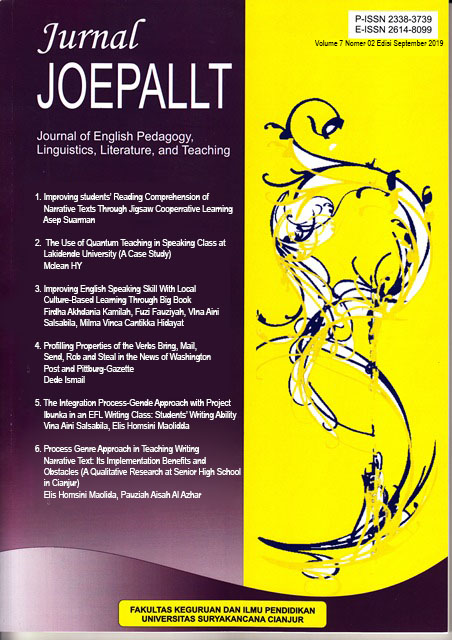
IMPROVING STUDENTS’ READING COMPREHENSION OF NARRATIVE TEXTS THROUGH JIGSAW COOPERATIVE LEARNING
DOI:
https://doi.org/10.35194/jj.v7i2.722Abstract
This study investigated the implementation of Jigsaw Cooperative Learning (JCL) in teaching reading comprehension in one of Junior High Schools in Serang Regency, Banten Province. It seeks to see how the JCL is implemented in the classroom, whether JCL can enhance students’ comprehension and whether the impact is positive or negative in students’ opinion. It employed classroom action research (CAR) with two cycles of actions, involving 31 students. To collect data, observation, tests and questionnaire were done. The implementation shows that, like other cooperative learning models, JCL requires students work in groups twice, in jigsaw and experts groups and require teachers do more preparation. The results of tests indicate that JCL improved students’ comprehension. There was gain of the mean, the highest score and the lowest one. In addition, the data from questionnaire show that in the students’ opinion, JCL impact on their literal comprehension is better than that on their inferential and evaluative comprehension meaning that the students are more aware of the impact on their literal comprehension than that on inferential and evaluative levels. It is suggested that similar study should include more items on every levels of comprehension, involve more students with various ages, be conducted in more cycles and use interview to collect data.References
Berry, J.H. (2005). Level of Reading Comprehension. Available online at www.sc4.edu
Brasell, D. & Rasinski, T. (2008). Comprehension that Works: Taking Students Beyond Ordinary Understanding to Deep Comprehension. Huntington Beach: Shell Education.
Briskin, L. (2005). A Guide To Active Reading And Asking Questions: A Handout For Students. Online article. Available at www.yorku.ca/laps/sosc/Foundations/documents/ActiveReading.pdf . Accessed on February 15. 2012.
Brown, H. D. (2001).Teaching by Principles, An Interactive Approach to Language Pedagogy. New York : Addison Wesley Longman.
Clymer, T. (1968). ‘What is “reading”?’: some current concepts. 67th Yearbook of National Society for the Study of Education, 1968, 7-29. In Pettit, N. T. and Cockriel, I. W. (1974). A Factor Study of the Literal Reading Comprehension Test and the Inferential Reading Comprehension Test. Journal of Literacy Research available on line at http://jlr.sagepub.com/content/6/1/63
Creswell, J. W. (2008). Educational Research: Planning, Conducting and Evaluating Quantitative and Qualitative Research. New Jersey: Pearson Education, Inc.
Dornyei, Z. (2002).Questionnaire in Second Language Research; Construction, Administration and Processing. Second Edition. New York: Routledge
Ghaith, G & El-Malak, M. A. (2004) Effect of Jigsaw II on literal and higher order EFL reading comprehension. Educational Research and Evaluation journal. Volume 10/2. Taylor & Francis Group
Grabe, W and Stoller, F.L. (2002). Teaching and Researching Reading. Harlow, England: Longman/Pearson Education.
Harmer, J. (2007). How to Teach English. Essex: Pearson Education Limited.
Hedgecock, J.S. and Ferris, D. R. (2009). Teaching Readers of English: Students, Texts and Contexts. New York: Routledge.
Heigham, J and Crocker, R. A. (2009).Qualitative Research in Applied Linguistics – Practical Introduction. Hampshire- England : Palgrave Macmillan.
Hood, S., Solomon, N., and Burns, A. (1996). Focus on Reading; New Edition. Sydney: National Centre for English Language Teaching and Research.
Hudson, T. (2007). Teaching Second Language Reading. Oxford: Oxford University Press.Hughes, A. (2003). Test for Language Teachers: Second Edition. Cambridge, U.K.: Cambridge University Press.
Jhonson, K. (2001). An Introduction to Language Learning and Teaching. Harlow Essex England: Pearson Education Limited.
Johannessen, L. R. Kahn, E.A., Walter, C.C. (2009). Writing about Literature; Second edition; Revised and Updated. Illinois: National Council of Teacher of English. Available online at https://secure.ncte.org/store/writing-about-literature-2ed.
Johnson, D. W. and Johnson, R. T. (1999). Theory into Practice. Vol 38 No. 2. Building Community through Cooperative Learning. Lawrence Erlbaum Associates.
Joyce, B., Weil, M. and Calhoun, E. (2011). Models of Teaching; Eighth Edition. USA: Pearson Education, Inc.
Kazemi, M. (2012). The Effect of Jigsaw Technique on the Learners’ Reading Achievement: The Case of English as L2. MJAL 4:3 Autumn 2012.
Kemmis, S., & McTaggart, R. (1986). The Action Research Planner. Geelong, Victoria: Deakin University Press.
Kurnia, E. (2002) The effect of using cooperative learning by using jigsaw activities and the traditional technique on the reading comprehension achievement of SMU YPPI-I students, Surabaya. Undergraduate thesis, Widya Mandala Catholic University Surabaya.
Leighton, M.S. (1990). Cooperative Learning. in Cooper, M. J. 1990. Classroom Teaching Skills. Canada: Heath and Company.
Marzano, R. J., Pickering, D. J. and Pollock, J. E. (2001). Classroom Instruction that works. Research based strategy for increasing students achievemt. Alexandria, Virginia USA: Association for supervision and Curriculum Development.
McMillan, J. H., and Schumacher, S. (2001). Fifth Edition Research in Education; A Conceptual Framework. USA: Priscilla McGeehon.
Meng , J. (2010). Jigsaw Cooperative Learning in English Reading. Journal of Language Teaching and Research, Vol. 1, No. 4, pp. 501-504, July 2010 Finland : Academy Publisher .
Novianto, B. (2012). Improving Reading Comprehension Skills By Using Jigsaw Technique At The Second Year Of Sman 1 Kalasan Yogyakarta In The Academic Year Of 2011/2012. Thesis. English Language Education Department Faculty Of Arts And Languages Yogyakarta State University.
Oppenheim, A. N. (1992). Questionnaire, design, interviewing and attitude measurement. London Pinter Pub Ltd.
Robbani, F. (2017). The Effectiveness Of Jigsaw Technique To Teach Students’ Reading Comprehension At The Eighthgrade Students Of Mts N Gondang In The Academic Year 2015/2016. Thesis. English Education Study Program Islamic Education And Teacher Training Faculty The State Islamic Institute Of Surakarta.
Slavin, R. E. (1995). Cooperative Learning : Theory, research and Practice. Massachusetts: A Simon and Schuster Company Needham Heights.
Zakiyah, U. (2014). Increasing The Tenth Year Students’ Reading Comprehension Achievement By Using Jigsaw Iv Technique At Ma Darussalam Jember In The 2009/2010 Academic Year. Thesis. Faculty of Teacher Training and Education. Universitas Jember.
Online Resources
http://www.jigsaw.org/overview.htm
IAE, www. ibe.unesco.org
Downloads
Published
How to Cite
Issue
Section
License
I. Transfer of copyright
By execution of the present Statement Author transfers copyright and assigns exclusively to Publisher all rights, title and interest that Author may have (for the extent transferable) in and to the Article and any revisions or versions, but not limited to the sole right to print, publish and sell the Article worldwide in all languages and media. Transfer of the above rights is referred to as those of the final and published version of the Article but does not restrict Author to self-archive the preprint version of his/her paper.
II. Rights and obligations of Publisher
The Publisher rights to the Article shall especially include, but shall not be limited to:
Ability to publish an electronic version of the Article via the website
Distribution provided by or through joepallt from time to time, selling the Article world-wide (through subscriptions, Pay-per-View, single archive sale, etc.)
Publishing the Article in the printed Journals as listed on the official Website of Publisher
Transferring the copyright and the right of use of the Article.
Taking measures on behalf of the Author against infringement, inappropriate use of the Article, libel or plagiarism.
Publisher agrees to send the text of the Article to the e-mail address of Author indicated in the present Statement for preview before the first publishing either in paper and/or electronic format (Proof). Author shall return the corrected text of the Article within 1 week to the Publisher.
III. Rights and obligations of Author
The Author declares and warrants that he/she is the exclusive author of the Article or has the right to represent all co-authors of the and has not granted any exclusive or non-exclusive right to the Article to any third party prior to the execution of the present Statement and has the right therefore to enter into the present Statement and entitle the Publisher the use of the Article subject to the present Statement.
By executing the present Statement Author confirms that the Article is free of plagiarism, and that Author has exercised reasonable care to ensure that it is accurate and, to the best of Author's knowledge, does not contain anything which is libelous, or obscene, or infringes on anyone copyright, right of privacy, or other rights.
The preprint version is the Authors' manuscript or the galley proof or the Authors' manuscript along with the corrections made in the course of the peer review process. The Authors' right to self-archive is irrespective of the format of the preprint (.doc, .tex., .pdf) version and self-archiving includes the free circulation of this file via e-mail or publication of this preprint on the Authors' webpage or on the Authors' institutional repository with open or restricted access.
For any disputes arising from or in connection with the present Statement Parties agree in the exclusive competence of joepallt's publisher
Date and place of signature