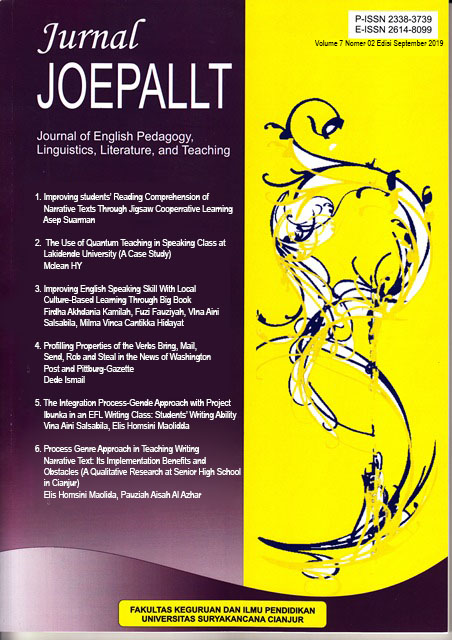
PROCESS GENRE APPROACH IN TEACHING WRITING NARRATIVE TEXT: ITS IMPLEMENTATION, BENEFITS AND OBSTACLES (A Qualitative Research at a Senior High School in Cianjur)
DOI:
https://doi.org/10.35194/jj.v7i2.656Abstract
Nowadays, teachers should be more creative and innovative in teaching.In the real condition, students still have difficulties in writing class. To improve students’ writing ability in writing various genres of text, the teacher should choose an innovative strategy. Process genre is one of the approaches commonly used in teaching writing. This research aims to find outthe useof Process Genre Approach in teaching the narrative text as well asthe benefitsand obstacles of using Process Genre Approach in teaching narrative text. This research applied qualitative research. The data of this research were collected from three instruments:classroom observation, questionnaire, and interview. This research was carried out in a senior high school in Cianjurby involving twenty-three students of ten-grade and an English teacher.The first finding shows that in applying process genre approach in teaching writing of narrative text, there were six steps conducted by the teacher following Badger and White (2000) steps: preparation, modeling, planning, join constructing, independent constructing, and revising and editing. The second finding showsthat there were some benefits of using Process Genre Approach in teaching writing narrative text. Teacher’s interview reveals that the benefits of using process genre approach in teaching writing narrative text were the students can write a text step by step and the students not only can write a text but they can learn about a genre of text in detail. In addition, students questionnaire discloses several benefits of using process genre approach in teaching writing narrative text such as the students are easier to write a text and the students can make a text in detail. The last finding shows there were two obstacles, the first was students’low grammar mastery and the second was students low vocabulary mastery.
References
Agesta, S., & Cahyono, B. Y. (2017). Effect of Process Genre Approach on The Indonesian EFL Writing Achievement Across Personality. International Journal of English Language and Linguistics Research, 38-48.
Azhar, M., Kiran, S., & Khan, T. (2016). Teaching Writing Skill Based on Process Genre Approach in Comunity Learning Context. SOCIOINT 3rd, 412-417.
Azmal, A., & College, C. (2015). Process Genre Approach to Teaching University Foundation Course Students in Pakistan. IAFOR, 1-6.
Badger, R., & White, G. (2000). A Process Genre Approach to Teaching Writing. ELT Journal, 54(2), 153-160.
Brown, H. D. (2004). Language AssessmentPrinciples and Classroom Practice. New York: Pearson Education, Inc
Creswell, J. W. (2014). Research Design (Fourth Edition). California: Sage Publications.
Gupitasari, H. (2013). The Implementation of Process Genre Approach to Teaching Writing Business Letter. Journal of English and Education, 1(1), 89-95.
Harmer, J. (2004). How to Teach Writing. England: Person Education Limited.
Harmer, J. (2007). How to Teach English . England: Person Education Limited.
Maolida, E.H. (2015). Dialogue Journal in Two EFL Writing Classrooms: Its Benefits andChallenges (A Case Study in a University in Cianjur). JOEPALLT, vol.3, hal. 33-53.
Maolida, E.H.,Mustika, G. (2018a). Students’ Writing Process for Project Ibunka: A Case Study of EFL Writers. JELTL (Journal of English Language Teaching and Linguistics) Vol. 3(3) DOI: http://dx.doi.org/10.21462/jeltl.v3i3.147
Multivah, L. (2018). The implementation of Speechnote Application in Teaching Speaking at Senior High School. Cianjur: Suryakanacana University.
Pramila, N. (2017). Approaches to Teaching English Writing: A research Note. Studies in Foreign Language Education, 39, 141-148.
Purnamasari, Y. (2015). Reading for General Communication II. Cianjur: Suryakancana University.
Rusinovci, X. (2015). Teaching Writing Through Process Genre Based Approach. Us-China Education Review, 5(10), 699-705.
Salikin, H., & Zulfikar, S. (2017). The Social Media-Based Approach in Teaching Writing at Jember University, Indonesia. International Journal of English Linguistics, 7 (3), 1-13.
Saputra, H., & Marzulina, L. (2015). Teaching Writing by Using Process Genre Approach to The Eight Grade Students of SMP Negeri 22 Palembang. Jurnal Pendidikan dan Pengajaran, 1-12.
Setiadi, A. B. (2006). Metode Penelitian Untuk Pengajaran Bahasa Asing Pendekatan Kuantitatif dan Kua;itatif. Yogyakarta: Graha Ilmu.
Downloads
Published
How to Cite
Issue
Section
License
I. Transfer of copyright
By execution of the present Statement Author transfers copyright and assigns exclusively to Publisher all rights, title and interest that Author may have (for the extent transferable) in and to the Article and any revisions or versions, but not limited to the sole right to print, publish and sell the Article worldwide in all languages and media. Transfer of the above rights is referred to as those of the final and published version of the Article but does not restrict Author to self-archive the preprint version of his/her paper.
II. Rights and obligations of Publisher
The Publisher rights to the Article shall especially include, but shall not be limited to:
Ability to publish an electronic version of the Article via the website
Distribution provided by or through joepallt from time to time, selling the Article world-wide (through subscriptions, Pay-per-View, single archive sale, etc.)
Publishing the Article in the printed Journals as listed on the official Website of Publisher
Transferring the copyright and the right of use of the Article.
Taking measures on behalf of the Author against infringement, inappropriate use of the Article, libel or plagiarism.
Publisher agrees to send the text of the Article to the e-mail address of Author indicated in the present Statement for preview before the first publishing either in paper and/or electronic format (Proof). Author shall return the corrected text of the Article within 1 week to the Publisher.
III. Rights and obligations of Author
The Author declares and warrants that he/she is the exclusive author of the Article or has the right to represent all co-authors of the and has not granted any exclusive or non-exclusive right to the Article to any third party prior to the execution of the present Statement and has the right therefore to enter into the present Statement and entitle the Publisher the use of the Article subject to the present Statement.
By executing the present Statement Author confirms that the Article is free of plagiarism, and that Author has exercised reasonable care to ensure that it is accurate and, to the best of Author's knowledge, does not contain anything which is libelous, or obscene, or infringes on anyone copyright, right of privacy, or other rights.
The preprint version is the Authors' manuscript or the galley proof or the Authors' manuscript along with the corrections made in the course of the peer review process. The Authors' right to self-archive is irrespective of the format of the preprint (.doc, .tex., .pdf) version and self-archiving includes the free circulation of this file via e-mail or publication of this preprint on the Authors' webpage or on the Authors' institutional repository with open or restricted access.
For any disputes arising from or in connection with the present Statement Parties agree in the exclusive competence of joepallt's publisher
Date and place of signature