Author Guidelines
AUTHOR GUIDELINES
1. Introduction
JUBIS is a scholarly journal dedicated to the development of knowledge and technology in the field of International Business Administration. It publishes high-quality, original research articles established in accordance with the decisions made at meetings of the Faculty of Applied Sciences leadership and formally authorized through a Dean's Decree concerning the appointment of the JUBIS Journal Management Team.
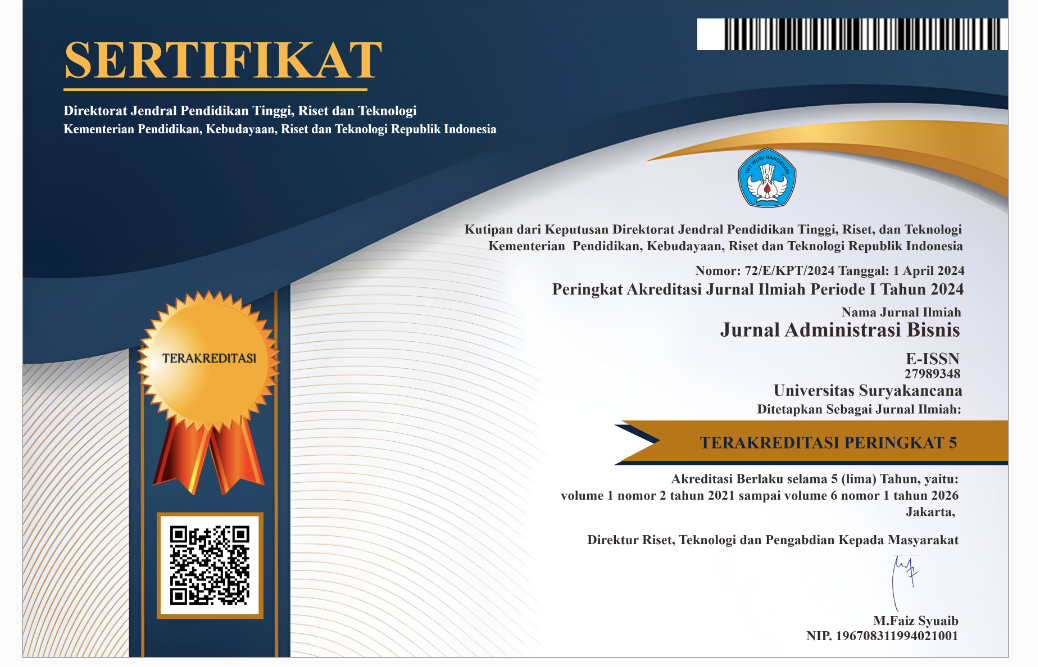
JUBIS is a peer-reviewed scientific journal published by the Institute for Research and Community Service (LPPM), Faculty of Applied Sciences, Universitas Suryakancana. The journal is published twice a year, in June and December. The first issue was Volume 1, Number 1, published in June 2021.
JUBIS aims to become a nationally and internationally recognized scholarly journal that disseminates and advances research findings and scholarly ideas in the field of International Business Administration.
2. Guidelines for Writing the Title, Author Names, Affiliations, and Abstract
2.1. Title and Author Information
The manuscript title must be provided in both Indonesian and English. The title must be written in bold uppercase letters, using 12-point font size, single line spacing, and must not exceed 15 words. The title should indicate the research topic clearly and concisely.
The title must be followed by the full names of the authors, without academic titles or professional designations, their institutional affiliations and email addresses. Author names, affiliations, and email addresses must be written in 12-point font without bold formatting.
If there is more than one author, the names must be separated by commas.
2.2. Abstract and Keywords
The abstract must be written in standard English, using either American English or British English consistently throughout the manuscript. An Indonesian-language abstract must also be provided in proper and standard Indonesian.
Both the English abstract and the Indonesian abstract must be written as a single paragraph, containing no bibliographical references or references to tables and figures. Each abstract must not exceed 150 words and must use Garamond, 12-point font, with single line spacing.
Each abstract must be accompanied by a maximum of five keywords.
The abstract must clearly present the research problem, objectives, methods, results, and conclusions. Excessive numerical details should be avoided. Abbreviations should not be used unless the terms are used more than once in the manuscript.
3. General Manuscript Guidelines
The following general guidelines must be observed when preparing and submitting manuscripts to JUBIS:
-
Manuscripts must report original research and must not have been previously published in any journal or other publication.
-
Manuscripts must be free from plagiarism and must comply with accepted standards of research and publication ethics.
-
Manuscript submission and the publication process are free of charge, with no additional publication fees.
-
Authors are required to cite at least three relevant articles published in JUBIS within the last five years, provided that these articles are relevant to the topic of the submitted manuscript.
-
JUBIS accepts research manuscripts in the field of International Business Administration. Manuscripts must be submitted online through the Open Journal Systems (OJS) platform at: https://jurnal.unsur.ac.id/jubis/index. Authors must register on the website and select the author role before submitting their manuscripts.
-
The official article template can be downloaded from the journal website.
-
Manuscripts that do not comply with the author guidelines will be returned to the authors for revision before proceeding to the next stage of editorial processing.
-
Manuscripts must include the following sections: Article Title, Abstract, Introduction, Research Methods, Results and Discussion, Conclusion, Acknowledgments (if applicable), and References.
-
Personal names mentioned in the manuscript must be written in bold, while foreign-language terms must be written in italics.
-
Manuscripts must be 10–15 pages long and prepared on A4 paper using Microsoft Word. The document must use Garamond, 12-point font, single line spacing, and 3 cm margins on all sides (top, bottom, left, and right).
-
Authors must provide a short curriculum vitae (CV) containing their names, institutional affiliations, email addresses, and educational backgrounds. All manuscript pages, including tables, appendices, and references, must be numbered consecutively. Every table and figure must have a sequential number, title, and source citation, where applicable.
-
In-text citations and references must follow the Cite Them Right, 10th edition, Harvard referencing style. The manuscript must use Garamond, 12-point font. The recommended references should include at least five books and ten journal articles. Books should generally have been published within the last ten years, while journal articles should generally have been published within the last five years.
3.1. In-Text Citation Style
The following examples illustrate the required citation style.
a. Books
-
(Najiyati et al., 2005)
-
(Oetami Dwi Hajoeningtijas, 2012)
b. Journal Articles
-
(Marina, 2017)
-
(Supena, 2010)
c. Conference Papers, Proceedings, Seminar Papers, and Other Scholarly Works
-
(Suryanto, 2004)
-
(Indrawati, Harijati and Pertiwi, 2011)
3.2. Reference List Examples
References must be arranged alphabetically by the authors' surnames and formatted according to the Cite Them Right, 10th edition, Harvard referencing style.
Indrawati, E., Harijati, S. and Pertiwi, P.R. (2011) ‘Permodelan Pemberdayaan Kelompok Tani Dalam Penjaminan Keberlanjutan Usahatani Pinggiran Perkotaan (Kasus Dinamika Kelompok Petani Sayuran di Kabupaten Sleman Yogyakarta)’, Seminar Nasional FMIPA-UT 2011, pp. 1–17. Available at: http://repository.ut.ac.id/2418/1/fmipa201129.pdf.
Marina, I. (2017) ‘Strategi Pengembangan Agribisnis Hasil Pertanian Melalui Inovasi Dan Kreatifitas Menjadi Produk Unggulan Di Smk Negeri 1 Pacet Kabupaten Cianjur’, Mimbar Agribisnis: Jurnal Pemikiran Masyarakat Ilmiah Berwawasan Agribisnis, 1(1), p. 45. doi: 10.25157/ma.v1i1.31.
Najiyati, S. et al. (2005) Panduan Pengelolaan Lahan Gambut.
Oetami Dwi Hajoeningtijas (2012) Mikrobiologi Pertanian. Yogyakarta: Graha Ilmu.
Supena, M.H. (2010) ‘Sistem Pemasaran Ikan Hias Black Ghost (Apteronotus albifrons) di Terminal Agribisnis (Holding Ground) Rancamaya Bogor’, Jurnal Penyuluhan Perikanan dan Kelautan, 4(2), pp. 97–105. doi: 10.33378/jppik.v4i2.21.
Suryanto, B. (2004) ‘Peran Usaha Tani Ternak Ruminansia dalam Pembangunan Agribisnis Berwawasan Lingkungan’, in Pidato Pengukuhan: Upacara Peresmian Penerimaan Jabatan Guru Besar dalam Ilmu Manajemen Usahatani.
4. Manuscript Structure
Manuscripts submitted to JUBIS must follow the structure below:
-
Title
-
Abstract
-
Introduction
-
Research Methods
-
Results and Discussion
-
Conclusion
-
Acknowledgments (if applicable)
-
References
Authors should ensure that each section is clearly organized and that the manuscript follows the journal's prescribed format.
5. Author Biography (Curriculum Vitae)
Authors must provide a curriculum vitae containing the following information:
-
Full name
-
Place and date of birth
-
Home address
-
Institutional or office address
-
Occupation or professional position
-
Telephone or mobile phone number
-
Email address
-
Educational background
-
Employment history
-
Workshops attended
-
Seminars attended
-
Training and professional development activities
The CV must be signed by the author.
6. Author Declaration Letter
Authors must submit a signed declaration confirming that the manuscript submitted to JUBIS is original, has not been previously published in any journal, and has not been published in any scientific forum or other scholarly publication.
The declaration must also confirm that the manuscript is not under consideration for publication elsewhere at the time of submission.
By submitting the manuscript, authors acknowledge their responsibility for the originality, accuracy, and ethical integrity of their work.