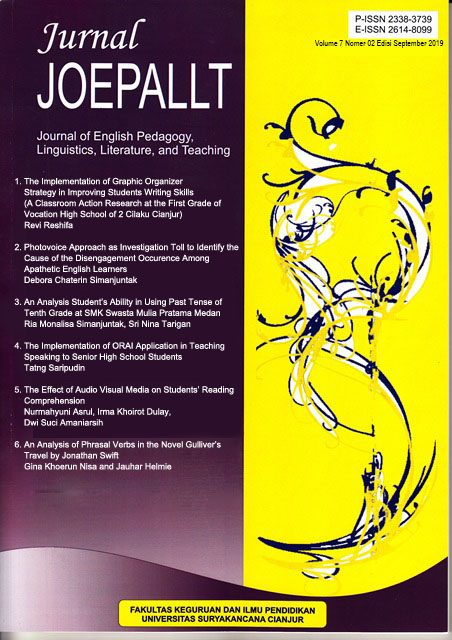
THE IMPLEMENTATION OF ORAI APPLICATION IN TEACHING SPEAKING TO SENIOR HIGH SCHOOL STUDENTS
DOI:
https://doi.org/10.35194/jj.v8i1.824Abstract
In this era, speaking is really important for us because English is international language. In Indonesia, most of students especially in senior high school are difficult to speak up because they are shy and they are not confident. In this era there are a lot of media for teaching, but sometimes people do not know how to use it. Many media can help teacher to teach speaking, like application in our phone. Orai is one of applications that can help teacher in teaching speaking and this application is easy to use. Therefore this study is aimed at finding out: (1) The implementation of Orai application in teaching speaking; (2) The obstacles of using Orai application in teaching speaking; and (3) Students’ response in implementing Orai application. This is a descriptive qualitative study. This study was conducted in a Senior High School in Cianjur, the participants were an English teacher and twenty eight students of the eleventh grade at social class 1 selected purposively. The instruments on this research cover classroom observation, guided interview, and open ended questionnaire. The data from those instruments were transcribed and categorized accordingly. The findings show that the teacher applied several main steps in using Orai application: introducing the application, explaining the purpose of Orai application in teaching speaking, downloading and installing the application, practicing speaking by using Orai application and getting feedbacks from the application. The application helps the teacher by giving instant feedbacks such as clarity, total filler words, pausing score, and energy score. In this case the students were enthusiastic when the teacher implemented the application. However, the students face some obstacles in speaking by using Orai application: the signal should be stable and good, students less confidence, students’ low mastery on operating Orai application and students confusion because the feedback was full in English. Even though there were some obstacles, the students gave a good response because the students more active and enthusiastic when the teacher implemented Orai application in teaching speaking.
Keywords: Speaking skill, Orai application, Senior High School, qualitative, obstacles
References
Creswell, J. W. (2008). Educatonal
Research Planning, conducting, and Evaluating Quantitative and Qualitative Research. United States of America: Pearson Education, Inc., Upper Saddle River, New Jersey 07458.
Creswell, J. W. (2013). Qualitative Inquiry: Choosing Among Five Approaches (3rd ed). SAGE Publication.
Halimah, Lustyantie, N., & Ibrahim,
G. A. (2018). Students’
Perception on the
implementation of Orai
Application in CLL Method
In Teaching Speaking. JEELS
Volume 5, 1-21.
Harmer, J. (2007). How to Teach English. Oxford: Ocelot Publishing.
HelmieJ. (2019) “Implementation of Dialogue Journal in Teaching Writing Descriptive Text”, IJET (Indonesian Journal of English Teaching), 8(1), pp. 90-104. doi: 10.15642/ijet2.2019.8.1.90-104.
14
Kelly, G. (2000). How to Teach Pronunciation. Harlow: Pearson.
Multivah, L. (2018). The
Implementation of
Speechnote in Teaching and
Learning Pronunciation in
EFL Classroom. Published.
Paper.
Pitriana, D. (2012). The Use of
Cartoon Movie Vocabulary
as Media in Teaching
Vocabulary to Young
Learner. Retrieved March 11,
2018 from
http://ejournal.unp.ac.id/inde
x.php./jelt/article/viewFile/12
81/1109.
Puspitasari., S. E. (2012). The
application of communicative
language teaching (CLT)
method to improve speaking
ability:salatiga: STAE islamic
studies institute (STAIN)
Retrieved on December 21st ,
2017 from
http://perpus.iainsalatiga.ac.id
/docfiles/fulltext/04ac1186ec
79e59e.pdf.
Ropikah., F. (2016). Iinvestigating
Students Difficulties in
Speaking English at a Senior
High School in
Cianjur.Published.Paper.
Spector, J. M., Merril, M. D., Elen, J., & Bishop, M. (2014). Handbook of Research on Educational Communications and Technology. New York: Springer Science+ Business Media.
Downloads
Published
How to Cite
Issue
Section
License
I. Transfer of copyright
By execution of the present Statement Author transfers copyright and assigns exclusively to Publisher all rights, title and interest that Author may have (for the extent transferable) in and to the Article and any revisions or versions, but not limited to the sole right to print, publish and sell the Article worldwide in all languages and media. Transfer of the above rights is referred to as those of the final and published version of the Article but does not restrict Author to self-archive the preprint version of his/her paper.
II. Rights and obligations of Publisher
The Publisher rights to the Article shall especially include, but shall not be limited to:
Ability to publish an electronic version of the Article via the website
Distribution provided by or through joepallt from time to time, selling the Article world-wide (through subscriptions, Pay-per-View, single archive sale, etc.)
Publishing the Article in the printed Journals as listed on the official Website of Publisher
Transferring the copyright and the right of use of the Article.
Taking measures on behalf of the Author against infringement, inappropriate use of the Article, libel or plagiarism.
Publisher agrees to send the text of the Article to the e-mail address of Author indicated in the present Statement for preview before the first publishing either in paper and/or electronic format (Proof). Author shall return the corrected text of the Article within 1 week to the Publisher.
III. Rights and obligations of Author
The Author declares and warrants that he/she is the exclusive author of the Article or has the right to represent all co-authors of the and has not granted any exclusive or non-exclusive right to the Article to any third party prior to the execution of the present Statement and has the right therefore to enter into the present Statement and entitle the Publisher the use of the Article subject to the present Statement.
By executing the present Statement Author confirms that the Article is free of plagiarism, and that Author has exercised reasonable care to ensure that it is accurate and, to the best of Author's knowledge, does not contain anything which is libelous, or obscene, or infringes on anyone copyright, right of privacy, or other rights.
The preprint version is the Authors' manuscript or the galley proof or the Authors' manuscript along with the corrections made in the course of the peer review process. The Authors' right to self-archive is irrespective of the format of the preprint (.doc, .tex., .pdf) version and self-archiving includes the free circulation of this file via e-mail or publication of this preprint on the Authors' webpage or on the Authors' institutional repository with open or restricted access.
For any disputes arising from or in connection with the present Statement Parties agree in the exclusive competence of joepallt's publisher
Date and place of signature