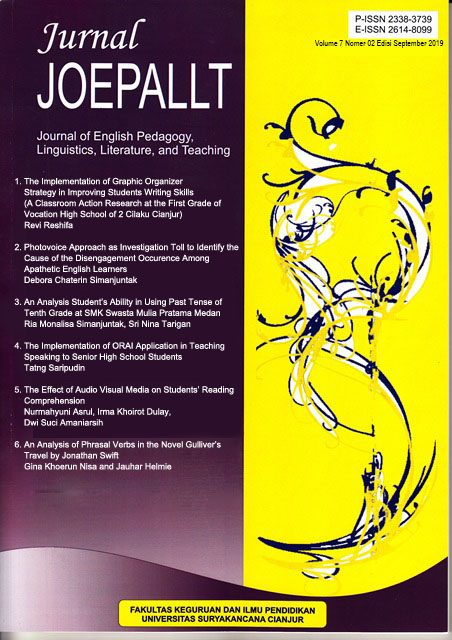
THE IMPLEMENTATION OF GRAPHIC ORGANIZER STRATEGY IN IMPROVING STUDENTS’ WRITING SKILLS ( A Classroom Action Research at the First Grade of Vocational High School of 2 Cilaku Cianjur)
DOI:
https://doi.org/10.35194/jj.v8i1.731Abstract
Writing skills is the ability to create something in a written form. This study was conducted to investigate the implementation of Graphic Organizer strategy to improve students’ writing skills. The subject of this research was the first-grade Graphic Design of Vocational High School of 2 Cilaku Cianjur, which involves 25 students. The implementation of Graphic Organizer strategy is an excellent teaching strategy for teaching students’ writing skill and building their critical thinking and also students’ creativity in writing. This study aims to investigate the process of Graphic Organizer Strategy in improving students’ writing skills, and students’ perception toward implementation Graphic Organizer Strategy. The method that used in this research was Classroom Action Research (CAR) method to identify and solve the problem on the students’ writing skills. The technique for data analyzing will be used cycle design from ( Strickland, 1987) in (Khasinah, 2013). The data were taken from observation, questionnaire, and test. The research was conducted in one class with 25 samples. It was applied in two cycles. Each cycle consists of six steps of action research (identified problem, plan research, collect data, analyze and interpret data, reflection, and share or take action). The research findings show that (1) the process of writing text in writing skill lesson using Graphic Organizer Strategy was interesting for students. (2) the results of the writing project in X Design Graphic class in writing skill using Graphic Organizer Strategy was improving. In the pre-cycle the average of the score was 64 or 20%, then in cycle I students’ score average was 74 or 48%, and for the last cycle, cycle II the average of students’ score was 82 or 76%. In cycle II, all students’ score was above the minimum achievement criteria that were 75. These result showed that students’ scores have achieved the achievement cycle. based on the results, it could be identified that using Graphic Organizer as the strategy in teaching writing could improve students’ writing skill.
Key Words: Writing Skills, Graphic Organizer Strategy, Classroom Action Research (CAR)
References
Students ’ Writing Project. Journal of English Language Teaching, 02(02), 105–111.
Retrieved from https://journal.lppmunindra.ac.i d
Badan Standar Nasional Pendidikan (BSNP). (2006). Standar Isi untuk Satuan Pendidikan Dasar dan Menengah.
Budiaji, W. (2013). LIKERT ( the measurement scale and the number of responses in likert scale ), 2(2), 127–133.
Retrieved from http://umbidharma.org//jipp
Cakrawati, T. D. (2012). The effect of
using communicative cartoon movies on the teaching of writing skill at the second grade of SMPN I Arjosari , Pacitan , East Java in the Academic Year of 2011 / 2012. Pacitan. (Thesis, University of Yogyakarta, 2012, Published). Retrieved from eprints.uny.ac.id
Harmer, J. (2007). How to teach English. (H. Gomm, Ed.), Education. Oxford: Ocelot Publishing.
Hervinia, B. A. (2016). The effectiveness of graphic organizers for teaching vocabulary of recount text. Retrieved from https://lib.unnes.ac.id
Issac, J. C. (2010). Methods and strategies of teaching: an overview. Pondicherry University Express.
Kawulich, B. (2012). Collecting Data through Observation. Katalog BPS, XXXIII(2), 81–87.
https://doi.org/10.1007/s13398- 014-0173-7.2
Khasinah, S. (2013). Classroom Action Research. Jurnal Pionir, 1, 107–114. Retrieved from jurnal.ar-raniry.ac.id
Madrid, M. M. M. (2012). Writing Text Itemms. Retrieved May 28, 2019, from https://www.slideshare.net/Mari aMarthaManetteMadrid
Stamper, J. B. (2006). Vocabulary building: graphic organizers and mini-lessons. Retrieved from www.robeson.k12.nc.us
Weigle, S. C. (2009). Assessing Writing. (Alderson & Bachman, Ed.). Cambridge: Cambridge University Press.
Wilbers, S. (2018). Five Elements of Effective Writing, 4, 1–2.
Retrieved from http://www.wilbers.com/elemen ts-wilbers.pdf
Yavani, Z. (2018). Improving
Students’ Writing Skills through Graphic Organizer in Process Writing. English Language Teaching-Echo, 3(1), 77–87.
Retrieved from www.syekhnurjati.ac.id
Yuniati, D. (2015). The effectiveness of picture pord inductive model (PWIM) for teaching writing recount text, 1–15. (Thesis, Muhammadiyah University Puwokerto, 2015, Published). Retrieved from repository.ump.ac.id
Downloads
Published
How to Cite
Issue
Section
License
I. Transfer of copyright
By execution of the present Statement Author transfers copyright and assigns exclusively to Publisher all rights, title and interest that Author may have (for the extent transferable) in and to the Article and any revisions or versions, but not limited to the sole right to print, publish and sell the Article worldwide in all languages and media. Transfer of the above rights is referred to as those of the final and published version of the Article but does not restrict Author to self-archive the preprint version of his/her paper.
II. Rights and obligations of Publisher
The Publisher rights to the Article shall especially include, but shall not be limited to:
Ability to publish an electronic version of the Article via the website
Distribution provided by or through joepallt from time to time, selling the Article world-wide (through subscriptions, Pay-per-View, single archive sale, etc.)
Publishing the Article in the printed Journals as listed on the official Website of Publisher
Transferring the copyright and the right of use of the Article.
Taking measures on behalf of the Author against infringement, inappropriate use of the Article, libel or plagiarism.
Publisher agrees to send the text of the Article to the e-mail address of Author indicated in the present Statement for preview before the first publishing either in paper and/or electronic format (Proof). Author shall return the corrected text of the Article within 1 week to the Publisher.
III. Rights and obligations of Author
The Author declares and warrants that he/she is the exclusive author of the Article or has the right to represent all co-authors of the and has not granted any exclusive or non-exclusive right to the Article to any third party prior to the execution of the present Statement and has the right therefore to enter into the present Statement and entitle the Publisher the use of the Article subject to the present Statement.
By executing the present Statement Author confirms that the Article is free of plagiarism, and that Author has exercised reasonable care to ensure that it is accurate and, to the best of Author's knowledge, does not contain anything which is libelous, or obscene, or infringes on anyone copyright, right of privacy, or other rights.
The preprint version is the Authors' manuscript or the galley proof or the Authors' manuscript along with the corrections made in the course of the peer review process. The Authors' right to self-archive is irrespective of the format of the preprint (.doc, .tex., .pdf) version and self-archiving includes the free circulation of this file via e-mail or publication of this preprint on the Authors' webpage or on the Authors' institutional repository with open or restricted access.
For any disputes arising from or in connection with the present Statement Parties agree in the exclusive competence of joepallt's publisher
Date and place of signature