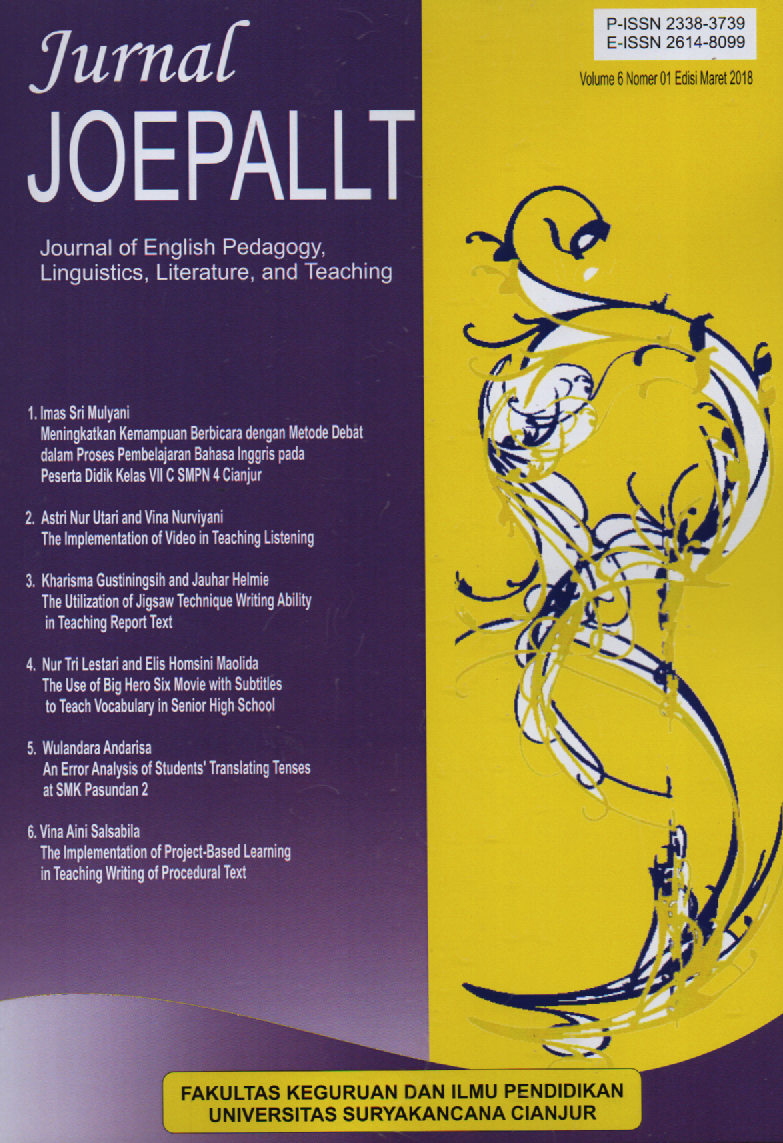
THE IMPLEMENTATION OF PROJECT-BASED LEARNING IN TEACHING WRITING OF PROCEDURAL TEXT
DOI:
https://doi.org/10.35194/jj.v6i1.384Abstract
This study aims to identify how project-based learning can help develop students’ writing ability in the form of procedural text. The study used a qualitative case study design. The data were collected through classroom observation, students’ writing, and interview which were analyzed qualitatively. The data show that PBL can develop students’ writing ability in which students improve their capacity in the concept of procedural text involving social function, schematic structure, and linguistic features.
Key Words: Project-based learning, writing, procedural text
References
BaÅŸ, G. (2011). Investigating the effects of project-based learning on students’ academic achievement and attitudes towards English lesson. TOJNED : The Online Journal Of New Horizons in Education, 1(4).
Bogdan, R., & Biklen, S. K. (1982). Qualitative research for education : An Introduction to Theory and Methods. Boston: Allyn and Bacon.
Chang, W.-J. (2014). Group communication and interaction in project-based learning: the use of facebook in a Taiwanese EFL context. International Journal of Learning, Teaching and Educational Research, 1(1), 108–130.
Chard, S. (2001). Project leaning. Retrieved from http://www.edutopia.org/chard.html. Accessed on February 8, 2015
Creswell, J.W. (1994). Research Design: Qualitative& Quantitative Approaches. California: SAGE Publication Inc.
Creswell, J. W. (2008). Research Design: Qualitative and Quanitative Approaches. New Delhi: SAGE Publication Work. Retrieved from https://www.heacademy.ac.uk/sites/default/files/peterdemian.pdf. Accessed on June 11, 2015
Derewianka, B. (1990). Exploring how texts work. Newtown: PETA.
Derewianka, B. (2011). A new grammar companion for teachers (First). Sydney: E:lit.
Derewianka, B. (2003). Trends and issues in genre-based approaches. RELC Journal, 34, 133-154. Retrieved from http: //doi.org/10.1177003368820303400202. Accessed on June 17, 2015
Derewianka , B., & Jones, P. (2012). Teaching Language in Context. Melbourne: Oxford University Press.
Emilia, E. (2005). A Critical Genre-Based Approach to Teaching Academic Writing in a Tertiaty EFL Context in Indonesia, 1. Retrieved from https://minerva-access.unimelb.edu.au/handle/11343/39548. Accessed on January 20, 2015
Emilia, E. (2011). Pendekatan genre based dalam pengajaran bahasa inggris: Petunjuk bagi guru. Bandung: Rizqi Press.
Emilia, E. (2013). A synthesis of approaches to teaching writing: A case study in an Australian primary school. Pakistan Journal of Social Science, 33(1), 121–135. Retrieved from http://www.bzu.edu.pk/PJSS/Vol33No12013/PJSS-Vol33-No1-11.pdf. Accessed on January 11, 2015
Fitria, S. (2013). Speaking activities in young learners classroom: the implementation of project-based learning approach. Skripsi. Universitas Pendidikan Indonesia, Bandung.
Foss, P., Carney, N., McDonald, K., & Rooks, M. (2006). Project-based learning activities for short-term intensive English programs.Retrieved from https://www.academia.edu/1592331/Project-based_learning_activities_for_short-term_intensive_English_programs. Accessed on 11 January 2015
Fraenkel, J.R., & Wallen, N.E. (1990). How to design and evaluate research in education. San Fransisco: McGraw-Hill
Gerot, L., & Wignell, P. (1994). Making sense of functional grammar. Sydney: Gerd Stabler.
Harmer, J. (1992). The practice of english language teaching. London: Longman.
Harmer, J. (2007). How to teach English. Essex, UK: Pearson Education Limited.
Helle, L., Tynjala, P., & Olkinuora, E. (2006). Project-based learning in post-secondary education – theory, practice and rubber sling shots. Higher Education, (51), 287–314.
Hilvonen, J., & Ovaska, P. (2010). Student motivation in project-based learning. International Conference on Engaging Pedagogy.
Kvale, S. (1996). Interviews: An introduction to qualitative research interviewing. London: SAGE Publications Ltd.
Lam, P. S. (2012). Project-based learning. In Seel, P.D. (Ed.), Encyclopedia of the Sciences of Learning (pp. 2707–2709). USA: Springer US. Retrieved from http://link.springer.com/referenceworkentry/10.1007/978-1-4419-1428-6_1095
Maulida, N. (2013). Speaking assessment technique using project-based learning. Skripsi. Universitas Pendidikan Indonesia, Bandung.
Nunan, D. (1992). Research method in language learning. New York: Cambridge University Press.
Nunan, D. (2003). Practical English language teaching. Singapore: McGraw Hill.
Poonpon, K. (2011). Enhancing English skills through project-based learning, English Teacher Journal, 40(10), 1-10
Schneider, D. K. (2005, November 18). Project-based learning. Retrieved from http://edutechwiki.unige.ch/en/Project-based_learning
Simpson, J. (2011, May). Integrating project-based learning in an english language tourism classroom in a thai university. Thesis. Australian Catholic University. Retrieved from http://dlibrary.acu.edu.au/digitaltheses/public/adt-acuvp309.29062011/02whole.pdf. Accessed on January 4, 2015
Stoller, F. L. (2002). Project work: A means to promote language and content. In Richards, J.C. & Renandya, W.A (Eds.). Methodology in Language Teaching: An Anthology of Current Practice, 107–120.Cambridge: Cambridge University Press
Termizi, M. (2009). The effect of project-based learning on pre-service teachers' environmental knowledge, attitude and behaviour. Master thesis, Universiti Sains Malaysia. Retrieved from http://pustaka2.upsi.edu.my/eprints/192/. Accessed on January 2, 2015
Thitivesa, D. (2014). The academic achievement of writing via project-based learning. World Academy of Science, Engineering and Technology International Journal of Social, Management, Economics and Business, Engineering 8(9).
Thomas, J. W. (2000, March). A review of research on project-based learning. Retrieved from http://www.newtechnetwork.org.590elmp01.blackmesh.com/sites/default/files/dr/pblresearch2.pdf
Tiangco, J. A. N. (2006). Project-based learning (pbl) assessment for efl/esl instruction: the philppine experience and its implications to taiwan. Retrieved from http://fllcccu.ccu.edu.tw/conference/2006conference/chinese/download/C39.pdf. Accessed on January 11, 2015
Yin, R.K. (2011). Qualitative research from start to finish (Kindle). New York: The Guilford Press.
Downloads
Published
How to Cite
Issue
Section
License
I. Transfer of copyright
By execution of the present Statement Author transfers copyright and assigns exclusively to Publisher all rights, title and interest that Author may have (for the extent transferable) in and to the Article and any revisions or versions, but not limited to the sole right to print, publish and sell the Article worldwide in all languages and media. Transfer of the above rights is referred to as those of the final and published version of the Article but does not restrict Author to self-archive the preprint version of his/her paper.
II. Rights and obligations of Publisher
The Publisher rights to the Article shall especially include, but shall not be limited to:
Ability to publish an electronic version of the Article via the website
Distribution provided by or through joepallt from time to time, selling the Article world-wide (through subscriptions, Pay-per-View, single archive sale, etc.)
Publishing the Article in the printed Journals as listed on the official Website of Publisher
Transferring the copyright and the right of use of the Article.
Taking measures on behalf of the Author against infringement, inappropriate use of the Article, libel or plagiarism.
Publisher agrees to send the text of the Article to the e-mail address of Author indicated in the present Statement for preview before the first publishing either in paper and/or electronic format (Proof). Author shall return the corrected text of the Article within 1 week to the Publisher.
III. Rights and obligations of Author
The Author declares and warrants that he/she is the exclusive author of the Article or has the right to represent all co-authors of the and has not granted any exclusive or non-exclusive right to the Article to any third party prior to the execution of the present Statement and has the right therefore to enter into the present Statement and entitle the Publisher the use of the Article subject to the present Statement.
By executing the present Statement Author confirms that the Article is free of plagiarism, and that Author has exercised reasonable care to ensure that it is accurate and, to the best of Author's knowledge, does not contain anything which is libelous, or obscene, or infringes on anyone copyright, right of privacy, or other rights.
The preprint version is the Authors' manuscript or the galley proof or the Authors' manuscript along with the corrections made in the course of the peer review process. The Authors' right to self-archive is irrespective of the format of the preprint (.doc, .tex., .pdf) version and self-archiving includes the free circulation of this file via e-mail or publication of this preprint on the Authors' webpage or on the Authors' institutional repository with open or restricted access.
For any disputes arising from or in connection with the present Statement Parties agree in the exclusive competence of joepallt's publisher
Date and place of signature