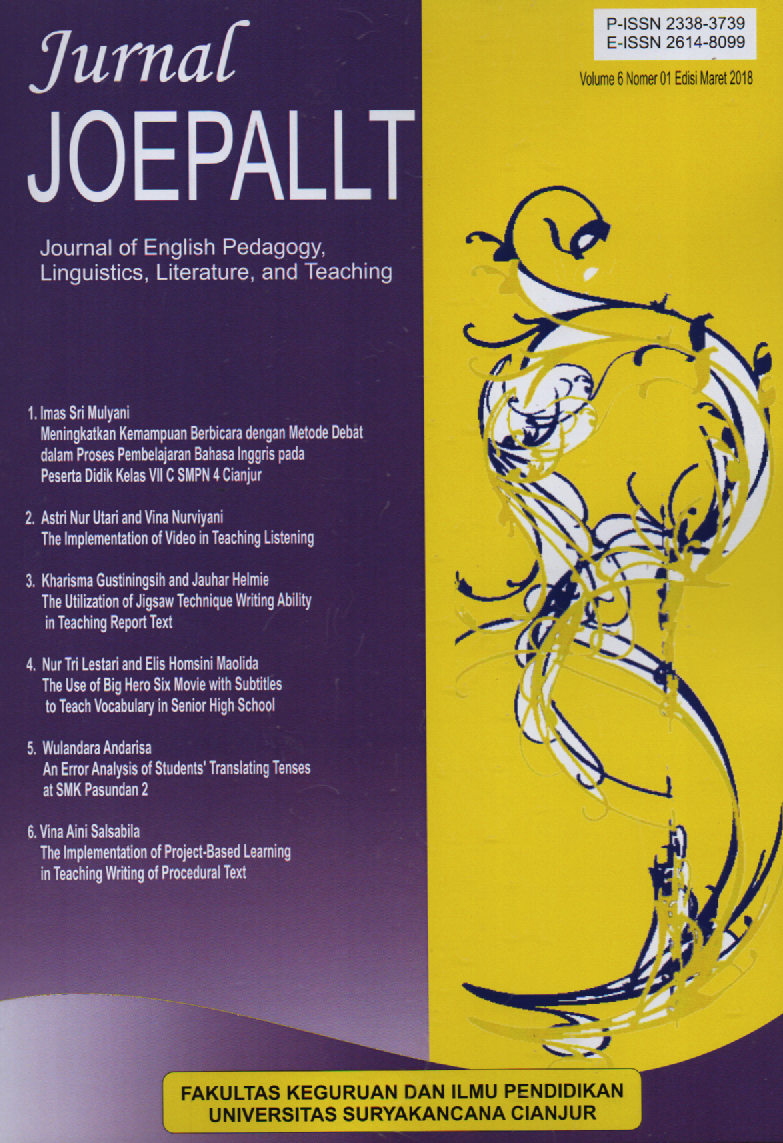
An Error Analysis of Students’ Translating Tenses at SMK Pasundan 2 Cianjur
DOI:
https://doi.org/10.35194/jj.v6i1.332Abstract
Abstract
The title of this paper is “An Error Analysis of Students’ Translating Tenses”. The goal of this research are to find out the kind of errors do the students commonly make in English-Indonesian translation, especialy in tenses and to find out the causes of their errors in English-Indonesian translation tenses. The method that the writer used in this research was descriptive qualitative as its method to analyze and describe entire data. The research participants of this study was the member of grade XII T-Eind’s Class at SMK 2 Pasundan Cianjur. The member of partisipants consisits of 47 male students. The data was taken from translation test and interview. After getting entire the data, then it was analyzed and describe it. Then after analyzing them, the writer found the kind of errors when students’ translating tenses. such as translation verb, translation to be, translation of “be”, translation of plural word and the unsuitable dictions of transfer the words from SL to TL in tenses. Based on the analysis the error when students translated verb in tenses consists of 83 erors from 423 data, the error when students translated to be in tenses consists of 53 errors from 423 data, the error when students translate “be” in tenses consists of 35 errors from 423 data, the error when translation plural of word consist of 8 errors from 423 data, and the unsuitable diction of translfer the word from SL to Tl in tenses consists of 37 erors from 423 data. Moreover the causes of students errors when they translated tenses are translation used word to word method, the students have not a good source language (English language), the students have not a good comprehension of vocabulary and the students not understand about tenses (present continuous tense, past continuous tense and future countinuous tense). Some suggestions was given to develop the learners’ competence and the reseacher hoped this study benefit for others reseachers as futhermore reference.
Keywords: translating, tenses, an error analysis.
References
Brislin, Richard W, ed. (1976). Translation: Applications and Research. New York; Gradner Press Inc.
Creswell, J.W. (1997). Qualitative Inquiry and Research Design Choosing Among Five Traditions. California: Sage Publications, Inc.
Eisner,E.W. (1991). The Enlightened Eye: Qualitative Inquiry and the
Enhancement of Educational Practice. New York: Macmilan.
Ellis, Rod. (1995). The Study of Second Language Acquisition. Oxford: Oxford University Press
Hornby, AS. (1975). Guide to Patterns and Usage in English. Oxford: Oxford University Press
Jeremy Harmer. (1989). The Principle of Language Learning and Teaching. New York: Prentice Hall Regents.
Kvale, S. (1996). Interviews: An Introduction to Qualitative Research
Interviewing. California: Sage Publications, Inc.
Newmark, Petter. (1988). A Textbook of Translation. New York: Sanghai Foreign Lnguage Education Press
Stephen Pit. Corder. (1974). Technique in Applied Linguistic, An Introduction to Second Language Acquisition Research. London: Oxford University Press.
Setiadi, A.B. (2006). Metode Penelitian untuk Pengajaran Bahasa Asing. Yogyakarta: Graha Ilmu
Yule, George. (1998). Explaining English Grammar. Oxford, UK: Oxford University Press
16
JOURNALS
Alwasilah, C.A. (2013). Policy on Foreign Language Education in Indonesia.
International Journal of Education, Vol7, No.1(1-19).
Chowdhury, Oxnov. (2011). Adventages and Disadventages of Interviews, Define Interview.
Syamsinar, M & Johari, B. (2014). Evaluation of English Foreign Language and It’s Curriculum in Indonesia.
Downloads
Published
How to Cite
Issue
Section
License
I. Transfer of copyright
By execution of the present Statement Author transfers copyright and assigns exclusively to Publisher all rights, title and interest that Author may have (for the extent transferable) in and to the Article and any revisions or versions, but not limited to the sole right to print, publish and sell the Article worldwide in all languages and media. Transfer of the above rights is referred to as those of the final and published version of the Article but does not restrict Author to self-archive the preprint version of his/her paper.
II. Rights and obligations of Publisher
The Publisher rights to the Article shall especially include, but shall not be limited to:
Ability to publish an electronic version of the Article via the website
Distribution provided by or through joepallt from time to time, selling the Article world-wide (through subscriptions, Pay-per-View, single archive sale, etc.)
Publishing the Article in the printed Journals as listed on the official Website of Publisher
Transferring the copyright and the right of use of the Article.
Taking measures on behalf of the Author against infringement, inappropriate use of the Article, libel or plagiarism.
Publisher agrees to send the text of the Article to the e-mail address of Author indicated in the present Statement for preview before the first publishing either in paper and/or electronic format (Proof). Author shall return the corrected text of the Article within 1 week to the Publisher.
III. Rights and obligations of Author
The Author declares and warrants that he/she is the exclusive author of the Article or has the right to represent all co-authors of the and has not granted any exclusive or non-exclusive right to the Article to any third party prior to the execution of the present Statement and has the right therefore to enter into the present Statement and entitle the Publisher the use of the Article subject to the present Statement.
By executing the present Statement Author confirms that the Article is free of plagiarism, and that Author has exercised reasonable care to ensure that it is accurate and, to the best of Author's knowledge, does not contain anything which is libelous, or obscene, or infringes on anyone copyright, right of privacy, or other rights.
The preprint version is the Authors' manuscript or the galley proof or the Authors' manuscript along with the corrections made in the course of the peer review process. The Authors' right to self-archive is irrespective of the format of the preprint (.doc, .tex., .pdf) version and self-archiving includes the free circulation of this file via e-mail or publication of this preprint on the Authors' webpage or on the Authors' institutional repository with open or restricted access.
For any disputes arising from or in connection with the present Statement Parties agree in the exclusive competence of joepallt's publisher
Date and place of signature