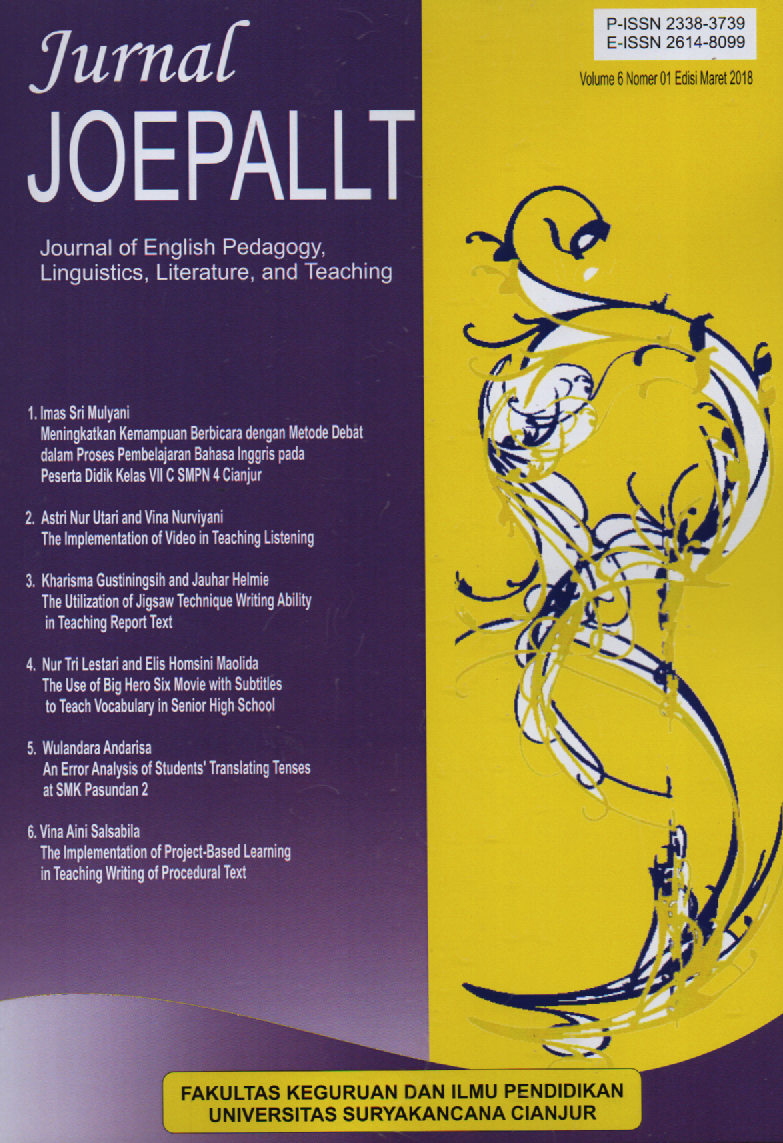
THE USE OF BIG HERO SIX MOVIE WITH SUBTITLES TO TEACH VOCABULARY IN SENIOR HIGH SCHOOL
DOI:
https://doi.org/10.35194/jj.v6i1.303Abstract
Abstract
This research entitled “The Use of Big Hero Six Movie with Subtitles to Teach Vocabulary in Senior High School”.The vocabulary learning is important and indispensable part of any language learning process to the learners. However, current teachers’ methods of teaching vocabulary seem not to be so effective that the quality is far from being satisfactory. In this case, the application of movies is considered one of the effective ways to teach vocabulary to the learners. Therefore, it is essential to get teachers and students to be familiarized with this relaxing but useful technique. This research intends to examine the use of movies to teach vocabulary form students. The research was carried out in SMA ISLAM AL-MAZIYAH at 10-3 class as a subject in the study. Qualitative method was applied and for triangulation purpose three data collection techniques were chosen such as observation, questionnaire and interview. The observation was conducted two times. To complete the data, the researcher used observation sheet during the learning process in the class. Beside that, the researcher used lesson plan to answer the first research question. Then, the questionnaire was conducted to answer second research question. To support the data, the questionnaire results were analysed after the observation. After the questionnaire the researcher used interview to answer the third research question, to complete the data the interview was conducted to the teacher. The result of study shows that the students is enthusiastic learning vocabulary through movie. Movie is good for facilitating thinking and problem solving, movie can be used in big class, students are naturally exposed to the myriad of authentic speech forms of the target language, it is simple and it helped the students to acquire new vocabularies that they never found in their student books. However, the teacher have a difficulties to teach vocabulary through movie. Such as, poor facility of the school copyright restriction of the movie, movie takes too much time, educational part may only be a small portion of the overall, movie may turn teacher and students become passive and movie requires more preparation.
Key word : Movies, Vocabulary.
References
Al-Sarhan, A. (2013). The Effects of Using Movies in Teaching Vocabulary,Bachelor Thesis With DVD at the back.
Alqahtani, M. (2015). The Important Vocabukary Learning How to be taugh. International Journal of Teaching and Education. file:///C:/U.pdfsers/User/Downloads/12-2-213%20(1). Accessed on March 05 2016
Brown, H. (1980). Teaching by principles, San francisco state university. Champoux, J.E. (1999). Film as a teaching resource. Journal of Management
Inquiry 8(2) : 240-251
Coady, J.&Huckin, T. (Eds.).(1997). Second language vocabulary acquisition.
Hamalik, O. (2001). Proses belajarmengajar.Jakarta: BumiAksara Cambridge: Cambridge University Press.
Nasution.(2005). TeknologiPendidikan. Jakarta: BumiAksara.
Sarrifudin, H. (2013). Definition of Learning Media, http://educationofsaint.blogspot.co.id/2013/06/definition-of-learning- media.html. . Access on April 15 2016
Pitriana, D (2012). The Use of Cartoon Movie Vocabulary as Media in Teaching Vocabulary to Young Learner. http://ejournal.unp.ac.id/index.php/jelt/article/viewFile/1281/1109. Accessed on March 15 2016.
Patton. (1990). Purposive Samplinghttp://research- methodology.net/sampling/purposive-sampling/. Access on June 02 2016 Ruusunen, V. (2011). USING MOVIES IN EFL TEACHING: the point of view of teachers. University of Jyväskylä Department of Languages English. https://jyx.jyu.fi/dspace/bitstream/handle/123456789/37097/URN:NBN:fi:jyu201
1121611812.pdf?sequence=1. Accessed on March 22 2016
Widiyawati, Y. (2010). The Use of Dora the Explore Cartoon Movie to Improve Vocabulary Mastery, A Classroom Action Research on the Fourth Year Students of SDN Selodoko I Kec. Ampel, Kab. Boyolali in Academic Year
2009/2010.
http://perpus.iainsalatiga.ac.id/docfiles/fulltext/154b4693a236ddb2.pdf. Accessed on Aprril 13 2016
Downloads
Published
How to Cite
Issue
Section
License
I. Transfer of copyright
By execution of the present Statement Author transfers copyright and assigns exclusively to Publisher all rights, title and interest that Author may have (for the extent transferable) in and to the Article and any revisions or versions, but not limited to the sole right to print, publish and sell the Article worldwide in all languages and media. Transfer of the above rights is referred to as those of the final and published version of the Article but does not restrict Author to self-archive the preprint version of his/her paper.
II. Rights and obligations of Publisher
The Publisher rights to the Article shall especially include, but shall not be limited to:
Ability to publish an electronic version of the Article via the website
Distribution provided by or through joepallt from time to time, selling the Article world-wide (through subscriptions, Pay-per-View, single archive sale, etc.)
Publishing the Article in the printed Journals as listed on the official Website of Publisher
Transferring the copyright and the right of use of the Article.
Taking measures on behalf of the Author against infringement, inappropriate use of the Article, libel or plagiarism.
Publisher agrees to send the text of the Article to the e-mail address of Author indicated in the present Statement for preview before the first publishing either in paper and/or electronic format (Proof). Author shall return the corrected text of the Article within 1 week to the Publisher.
III. Rights and obligations of Author
The Author declares and warrants that he/she is the exclusive author of the Article or has the right to represent all co-authors of the and has not granted any exclusive or non-exclusive right to the Article to any third party prior to the execution of the present Statement and has the right therefore to enter into the present Statement and entitle the Publisher the use of the Article subject to the present Statement.
By executing the present Statement Author confirms that the Article is free of plagiarism, and that Author has exercised reasonable care to ensure that it is accurate and, to the best of Author's knowledge, does not contain anything which is libelous, or obscene, or infringes on anyone copyright, right of privacy, or other rights.
The preprint version is the Authors' manuscript or the galley proof or the Authors' manuscript along with the corrections made in the course of the peer review process. The Authors' right to self-archive is irrespective of the format of the preprint (.doc, .tex., .pdf) version and self-archiving includes the free circulation of this file via e-mail or publication of this preprint on the Authors' webpage or on the Authors' institutional repository with open or restricted access.
For any disputes arising from or in connection with the present Statement Parties agree in the exclusive competence of joepallt's publisher
Date and place of signature