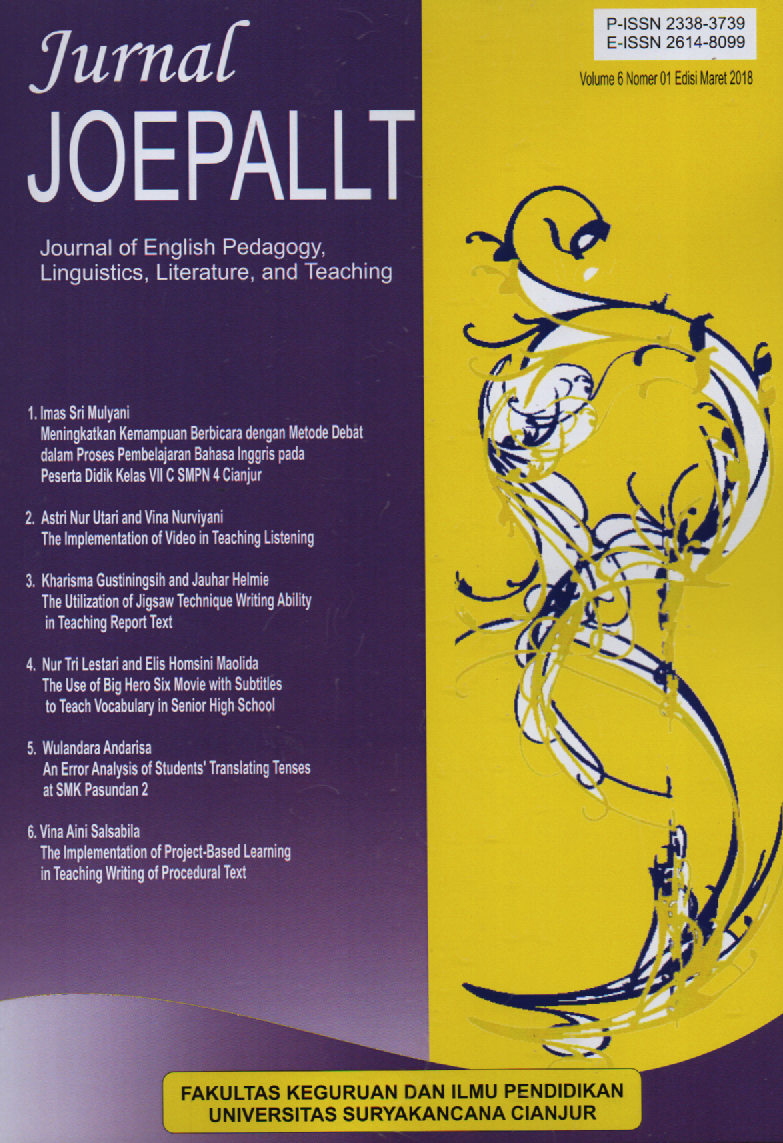
THE IMPLEMENTATION OF VIDEO IN TEACHING LISTENING
DOI:
https://doi.org/10.35194/jj.v6i1.302Abstract
ABSTRACT
According to Meyer (2002) in Muniandy and Veloo (2011:173; cited in Tugiwati, 2014) defines video as a kind of multimedia material consisting of verbal and non-verbal presentations displaying simultaneous images, narration and on screen text. Video is an electronic device that produces live images with a sounds. The major goals of this study were to investigate the implementing of video in teaching listening, the object of this study is the second grade students in senior high school. This study employed a classroom action research. Classroom action research on this study was conducted in two cycles. There are four steps in each cycle; planning, action, observation, and reflections. The data of this study were analyzed by using mix method, both of quantitative and qualitative. For quantitative method, the researcher used test to collect the data. While for qualitative method, it was analyzed by using questionnaire and observation. The test is used by the researcher to measure student’s listening skill improvement. In each cycle the researcher conducted pre-test and post-test. The questionnaires were used to support the data. Observation was used to evaluate the learning processes. The results show that the use of video in teaching listening was success to improve students’ achievement. It can be seen from the result of each test in each cycle. In cycle 1 the mean scores of pre-test 1 was 53.06, post-test 1 was
57.83. While in cycle 2, pre-test 2 was 71.94, post-test 2 was 75.81. The result of questionnaires shows that the students could understand the content of the video easily. The result of observation showed that video could create fun learning.
Keywords: listening, video, teaching listening, teaching listening through video
References
Kamilah, M. (2013). The Use of Contextual Video to Improve Students` Listening Ability. English Education Study Program of Indonesia University of Education, Journal of English and Education 2013, 1(1) 122-
132. Retrieved on May 26th, 2016. From:
http://webcache.googleusercontent.com
Khasanah, U. (2011). Improving Listening Skill Through Storytelling. Salatiga: State Islamic Studies Insitute. Retrieved on June 26th, 2016. From: http://perpus.iainsalatiga.ac.id/docfiles/fulltext/2dbdcdbe1fafdf3f.pdf
Kusumayati, L. D. (2010). Improving Students’ Vocabulary Mastery Using Contextual Teaching and Leaning. Surakarta: Universitas Sebelas Maret. Retrieved on June 9th, 2016. From: https://core.ac.uk/download/pdf/12348780.pdf
Nation, I. S. P. and Newton, Jonathan. (2009). Teaching ESL/EFL Listening and Speaking. Routledge: New York.
Nurviyani, V. (2014). The English Teachers’ Understanding of Genre Based Approach: Application and Difficulties in Teaching-Learning Activities. Bandung: Indonesia University of Education.
Sulistyanto, Irwan. (2015). Teaching Listening at The Second Grade of SMAN 1 Karangrejo. Retrieved on June 9th, 2016. From: https://www.academia.edu/15059753/Teaching_Listening_Journal
Tugiwati, D. (2014). The Use of Video to Improve the Listening Skills. (Thesis, English Education Department, Faculty of Language and Arts, Yogyakarta State University, 2014). Retrieved on March 31th, 2016. From: http://eprints.uny.ac.id/18508/1/Dwi%20Tugiwati%2009202241029.pdf
Woottipong, K. (2014). Effect of Using Video Materials in the Teaching Listening Skills for University Students. International Journal of Linguistics ISSN 1948-5425 2014, Vol. 6, No. 4. Retrieved on January 1th, 2016. From: http://www.macrothink.org/journal/index.php/ijl/article/viewFile/5870/pdf
_125
Downloads
Published
How to Cite
Issue
Section
License
I. Transfer of copyright
By execution of the present Statement Author transfers copyright and assigns exclusively to Publisher all rights, title and interest that Author may have (for the extent transferable) in and to the Article and any revisions or versions, but not limited to the sole right to print, publish and sell the Article worldwide in all languages and media. Transfer of the above rights is referred to as those of the final and published version of the Article but does not restrict Author to self-archive the preprint version of his/her paper.
II. Rights and obligations of Publisher
The Publisher rights to the Article shall especially include, but shall not be limited to:
Ability to publish an electronic version of the Article via the website
Distribution provided by or through joepallt from time to time, selling the Article world-wide (through subscriptions, Pay-per-View, single archive sale, etc.)
Publishing the Article in the printed Journals as listed on the official Website of Publisher
Transferring the copyright and the right of use of the Article.
Taking measures on behalf of the Author against infringement, inappropriate use of the Article, libel or plagiarism.
Publisher agrees to send the text of the Article to the e-mail address of Author indicated in the present Statement for preview before the first publishing either in paper and/or electronic format (Proof). Author shall return the corrected text of the Article within 1 week to the Publisher.
III. Rights and obligations of Author
The Author declares and warrants that he/she is the exclusive author of the Article or has the right to represent all co-authors of the and has not granted any exclusive or non-exclusive right to the Article to any third party prior to the execution of the present Statement and has the right therefore to enter into the present Statement and entitle the Publisher the use of the Article subject to the present Statement.
By executing the present Statement Author confirms that the Article is free of plagiarism, and that Author has exercised reasonable care to ensure that it is accurate and, to the best of Author's knowledge, does not contain anything which is libelous, or obscene, or infringes on anyone copyright, right of privacy, or other rights.
The preprint version is the Authors' manuscript or the galley proof or the Authors' manuscript along with the corrections made in the course of the peer review process. The Authors' right to self-archive is irrespective of the format of the preprint (.doc, .tex., .pdf) version and self-archiving includes the free circulation of this file via e-mail or publication of this preprint on the Authors' webpage or on the Authors' institutional repository with open or restricted access.
For any disputes arising from or in connection with the present Statement Parties agree in the exclusive competence of joepallt's publisher
Date and place of signature