(A Quasi-Experimental Study at the Tenth Grade Students of SMA Negeri 1 Cibeber)
DOI:
https://doi.org/10.35194/jj.v5i1.182Abstract
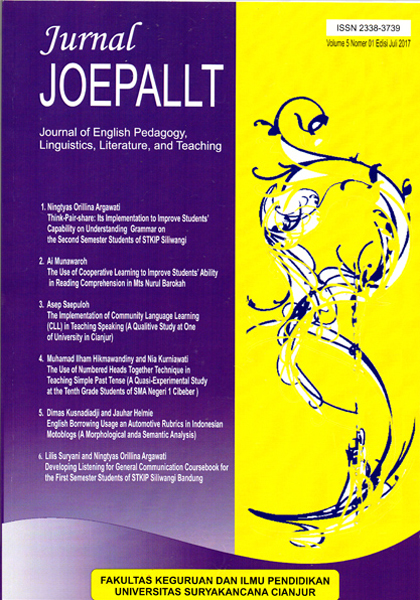
THE USE OF NUMBERED HEADS TOGETHER TECHNIQUE
IN TEACHING SIMPLE PAST TENSE
Muhamad Ilham Hikmawandiny
Nia Kurniawati
Abstract
The research was aimed at discovering whether Numbered Heads Together technique is effective to improve students’ ability in simple past tense and finding out the student’s responses toward this technique. The quasi-experimental design was utilized in order to collect the data. This quantitative research involved two classes of tenth grade at one senior high school in Cianjur in which one class was assigned as the experimental class and the other one was assigned as the control class. The instruments used were pre-test, post-test, and questionnaire attitudes towards the Numbered Heads Together technique. The pre-test was conducted in which the pre-test mean scores were the bases in identifying the initial learning framework of the participants. After conducting the selected lessons that employed the Numbered Heads Together technique in experimental class and employed Grammar Translation Method in control class, the students of both classes were given a post-test. The gain score of the two classes were compared by using Independent t-test. Results showed that the significance value was less than the significance level which was 0.032 < 0.05. It means that the Numbered Heads Together technique is effective to improve the students’ ability in simple past tense. Based on the questionnaire analysis, the findings showed that most of the students agreed that employing the Numbered Heads Together technique helps them to be more confident in term of participating because of group encouragement and benefits them to understand the hard concept of the learning material. Thus it can be concluded that the students’ responses toward the
Numbered Heads Together technique were positive.
Keywords: Numbered Heads Together, cooperative learning, simple past tense
References
Asl, Esmaeil H. et al., (2015). Comparative Study of Grammar Translation Method (GTM) and Communicative Language Teaching (CLT) in Language Teaching Methodology. Human Journals. 1(3), pp. 16-26.
Azar, B. S. (1992) Fundamentals of English Grammar. New Jersey: Prentice Hall.
Best, J.W., & Khan, J.V. (1995). Research in Education (7th ed.). New Delhi: Houghton Mifflin Company.
Cayabyab, E. C., & Jacobs, G. M. (1999). Making small groups work via cooperativelearning. The ACELT Journal, 3(2), 27-31.
Coolidge, F.I. (2000). Statistics: A gentle introduction. London, Thousand Oaks, New Delhi: SAGE Publications.
Hatch, E., & Farhady, H. (1982). Research design and statistics for applied linguistics. Rowley: Newbury House Publishers. Inc.
Haydon, T., Maheady, L., & Hunter, W. (2010). Effects of numbered heads together on the daily quiz scores and on-task behavior of students with disabilities. Journal of Behavioral Education, 19(3), 222-238. doi:10.1007/s10864-010-9108-3.
Hizbullah (2010). Teaching simple Past Tense by Using Cooperative Learning. Jakarta: Syarif Hidayatullah State Islamic University.
Johnson, D. W., & Johnson, R. T. (2009). An educational psychology success story: Social interdependence theory and cooperative learning. Educational researcher, 38(5), 365-379.
Kemendikbud. (2016). Permendikbud No. 21 tentang Standar Isi Pendidikan Dasar dan Menengah. Jakarta: Kementerian Pendidikan dan Kebudayaan
Kessler, Carolyn. (1992). Cooperative Language Learning. New Jersey: Prentice-
Hall
Lersen-Freeman, D. (2000). Technique and Principles in Language Teaching. New York: Oxford University Press.
Maheady, L., Michielli-Pendl, J., Harper, G. F., & Mallette, B. (2006). The effects of numbered heads together with and without an incentive package on the science test performance of a diverse group of sixth graders. Journal of Behavioral Education, 15(1), 25-39. doi:10.1007/s10864-005-9002-6.
Mahmud, N. (2003). English fo Muslim University Students (3rd ed). Jakarta: Pusat Bahasa dan Budaya Universitas Islam Negeri Jakarta.
Malik, R. S. & Hamied, F. A. (2014). Research Methods: A Guide For First Time Researchers. Bandung: UPI Press.
Mart, C. T. (2013). The Grammar-Translation Method and the Use of Translation to Facilitate Learning in ESL Classes. Journal of Advances in English Language Teaching, 1(4), pp-103.
Quirk, R. & Greenbaum, S. (1985) A University Grammar of English. Essex: Longman Group Limited.
Rahmi, R., & Syahputra, M. (2016). The Use of Number Heads Together (NHT) in Teaching Speaking for Junior High School. Getsempena English Education Journal, 2(1).
Ridwan, S. F. (2014). The effectiveness of Jigsaw Technique in Teaching Simple Past Tense. Jakarta: Syarif Hidayatullah State Islamic University.
Syawalia, T. S. (2013). Cooperative Learning in Subject English Reading Skill: A Quasi Experimental Study on the First Grade in Private Senior High School
(Doctoral dissertation, Universitas Pendidikan Indonesia)
Syukron, M. B., Suryanti, Y., & Sofyan, D. (2016). An Anaysis on
Students’difficulties in Understanding Simple Past Tense and Present
Perfect Tense. Jurnal Online Mahasiswa (JOM) Bidang Pendidikan Bahasa Inggris, 1(1).
Tsay, M., & Brady, M. (2010). A Case Study of Cooperative Learning and Communication Pedagogy: Does Working in Teams Make a Difference?.
Journal of the Scholarship of Teaching and Learning, 10(2), 78-89.
Downloads
Published
How to Cite
Issue
Section
License
I. Transfer of copyright
By execution of the present Statement Author transfers copyright and assigns exclusively to Publisher all rights, title and interest that Author may have (for the extent transferable) in and to the Article and any revisions or versions, but not limited to the sole right to print, publish and sell the Article worldwide in all languages and media. Transfer of the above rights is referred to as those of the final and published version of the Article but does not restrict Author to self-archive the preprint version of his/her paper.
II. Rights and obligations of Publisher
The Publisher rights to the Article shall especially include, but shall not be limited to:
Ability to publish an electronic version of the Article via the website
Distribution provided by or through joepallt from time to time, selling the Article world-wide (through subscriptions, Pay-per-View, single archive sale, etc.)
Publishing the Article in the printed Journals as listed on the official Website of Publisher
Transferring the copyright and the right of use of the Article.
Taking measures on behalf of the Author against infringement, inappropriate use of the Article, libel or plagiarism.
Publisher agrees to send the text of the Article to the e-mail address of Author indicated in the present Statement for preview before the first publishing either in paper and/or electronic format (Proof). Author shall return the corrected text of the Article within 1 week to the Publisher.
III. Rights and obligations of Author
The Author declares and warrants that he/she is the exclusive author of the Article or has the right to represent all co-authors of the and has not granted any exclusive or non-exclusive right to the Article to any third party prior to the execution of the present Statement and has the right therefore to enter into the present Statement and entitle the Publisher the use of the Article subject to the present Statement.
By executing the present Statement Author confirms that the Article is free of plagiarism, and that Author has exercised reasonable care to ensure that it is accurate and, to the best of Author's knowledge, does not contain anything which is libelous, or obscene, or infringes on anyone copyright, right of privacy, or other rights.
The preprint version is the Authors' manuscript or the galley proof or the Authors' manuscript along with the corrections made in the course of the peer review process. The Authors' right to self-archive is irrespective of the format of the preprint (.doc, .tex., .pdf) version and self-archiving includes the free circulation of this file via e-mail or publication of this preprint on the Authors' webpage or on the Authors' institutional repository with open or restricted access.
For any disputes arising from or in connection with the present Statement Parties agree in the exclusive competence of joepallt's publisher
Date and place of signature