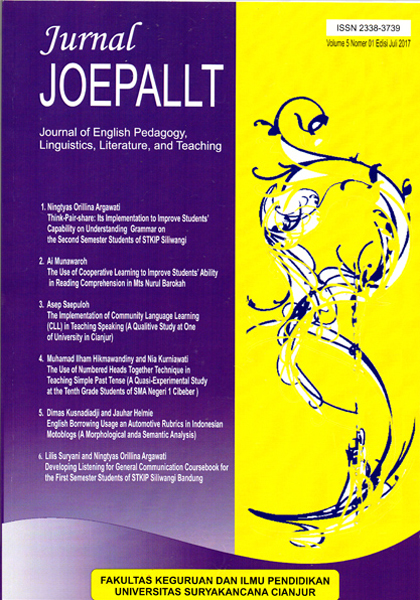
THINK-PAIR-SHARE: ITS IMPLEMENTATION TO IMPROVE STUDENTS’ CAPABILITY ON UNDERSTANDING GRAMMAR ON THE SECOND SEMESTER STUDENTS OF STKIP SILIWANGI
DOI:
https://doi.org/10.35194/jj.v5i1.161Abstract
Abstract
Learning English as foreign language is considered difficult because it has its own systems and aspects that completely different from our mother tongue, such as the grammar, pronunciation, vocabulary, and cultural background of the language. Vocabuary is an important skill since we can not deliver meaning without words. However, learning English is not dealing only on vocabulary but also on grammar. Learning grammar becomes important since grammar can determine meaning of sentences. In the level of University students, it is quite difficult to make the students master all of the theme on grammar in one semester. Moreover, if it comes to conditional sentences. This topic really relays on the understanding of concepts. Once the students catch the concept, they will be able to solve some problems relate with the topic easily. To build their capability on understanding a concept of such a topic, teacher needs to figure out the appropriate way. Think-pair-share seems to be a good way to teach conditional sentences. The method used in conducting this research is Classroom Action Research. The research was conducted on two cycles with total meetings were seven; three meetings were for tests, and four meetings were for treatment. Each cycle covered the step of planning, acting, observing, and reflecting. From the data collected by the researcher, it can be concluded that the capability on understanding grammar of the second semester students of university level was improved. The improvements cover two points, they are: (1) improvement on their mean score. Mean score of pre-test was 4.1875, mean score of post-test 1 was 5.9625, while mean score of post-test 2 was 7.225. (2) improvement of their attitude and behaviour. It can be seen from their improvement of their activeness, enjoyment, curiousity and knowledge.
Key words: CAR, Grammar, Think-Pair-Share
References
Argawati, Ningtyas O. 2014. The Effectiveness of Think-Pair-Share to Teach Speaking to The Second Grade Students of SMA N 01 Kartasura Viewed From The Students’ Risk-Taking. Retrieved from Digital library UNS, Surakarta.
Azar, Betty Schrampfer. 1992. Fundamentals of English Grammar: Second Edition. New Jersey: Prentice Hall.
Brown, Douglas. 1994. Teaching by Principles, an Interactive Approach to Language Pedagogy. New Jersey: Prentice-Hall Inc
Burns, A. (1999). Colaborative action research for English language teacher. Cambridge:Cambridge University Press.
Burns, Anne. 2010. Doing Action Research in English Language Teaching. New York: Routledge.
Harmer, Jeremy. 1998. The Practice of English Language Teaching. London: Longman.
Isnaini, Eris. 2014. The Effectiveness Of Inquiry Based Teaching To Teach Grammar Viewed From Students’ Risk-Taking. Retrieved from Digital library UNS, Surakarta.
Lock, G. 1997. Functional English Grammar: an Introduction for Second Language Teachers. Cambridge: Cambridge University Press.
Lyman, Frank. 2008. Description of Exemplary Techniques and Methods. London: Prentice Hall.
Murphy, Raymond. 1994. English Grammar in Use: Second Edition. London: Cambridge University Press
Richards, J. C. & Rodgers, T. S. (2001). Approaches and Methods in Language Teaching. Cambridge: Cambridge University Press.
Rivers, Wilga M. 1987. Interactive Language Teaching. Cambridge: Cambridge University Press.
Ornstein, Allan C and Lasley, Thomas J. 2000. Strategies for Effective Teaching. New York: McGraw-Hill.
Published
How to Cite
Issue
Section
License
I. Transfer of copyright
By execution of the present Statement Author transfers copyright and assigns exclusively to Publisher all rights, title and interest that Author may have (for the extent transferable) in and to the Article and any revisions or versions, but not limited to the sole right to print, publish and sell the Article worldwide in all languages and media. Transfer of the above rights is referred to as those of the final and published version of the Article but does not restrict Author to self-archive the preprint version of his/her paper.
II. Rights and obligations of Publisher
The Publisher rights to the Article shall especially include, but shall not be limited to:
Ability to publish an electronic version of the Article via the website
Distribution provided by or through joepallt from time to time, selling the Article world-wide (through subscriptions, Pay-per-View, single archive sale, etc.)
Publishing the Article in the printed Journals as listed on the official Website of Publisher
Transferring the copyright and the right of use of the Article.
Taking measures on behalf of the Author against infringement, inappropriate use of the Article, libel or plagiarism.
Publisher agrees to send the text of the Article to the e-mail address of Author indicated in the present Statement for preview before the first publishing either in paper and/or electronic format (Proof). Author shall return the corrected text of the Article within 1 week to the Publisher.
III. Rights and obligations of Author
The Author declares and warrants that he/she is the exclusive author of the Article or has the right to represent all co-authors of the and has not granted any exclusive or non-exclusive right to the Article to any third party prior to the execution of the present Statement and has the right therefore to enter into the present Statement and entitle the Publisher the use of the Article subject to the present Statement.
By executing the present Statement Author confirms that the Article is free of plagiarism, and that Author has exercised reasonable care to ensure that it is accurate and, to the best of Author's knowledge, does not contain anything which is libelous, or obscene, or infringes on anyone copyright, right of privacy, or other rights.
The preprint version is the Authors' manuscript or the galley proof or the Authors' manuscript along with the corrections made in the course of the peer review process. The Authors' right to self-archive is irrespective of the format of the preprint (.doc, .tex., .pdf) version and self-archiving includes the free circulation of this file via e-mail or publication of this preprint on the Authors' webpage or on the Authors' institutional repository with open or restricted access.
For any disputes arising from or in connection with the present Statement Parties agree in the exclusive competence of joepallt's publisher
Date and place of signature