
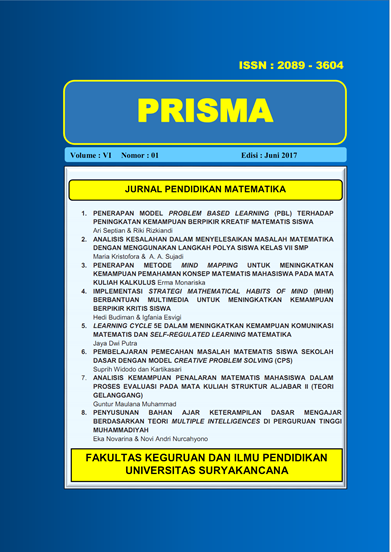
About the Journal

PRISMA (Online ISSN: 2614-4611; Print ISSN: 2089-3604) is an academic journal published twice a year (June and December) by Universitas Suryakancana in collaboration with the Indonesian Mathematics Educators Society (I-MES). The journal focuses on mathematics education and scholarly inquiry into the teaching and learning of mathematics. Its scope includes mathematics learning models, instructional media, curriculum in mathematics teaching, assessment and evaluation, ethnomathematics, didactical design, and lesson study in mathematics learning. PRISMA has been accredited at SINTA 3. Submitted manuscripts must be original research articles, written in English, and not under consideration by other journals or conferences. All submissions must follow the author guidelines and will undergo a double-blind peer review process.

Current Issue

Vol. 15 No. 1 (2026): PRISMA
Published: 2026-06-05

Articles

  • More Than AI: Developing Intelligent Chatbot to Empower Algebra Mastery for Grade VII Students

    Muhammad Nur Ramadhan, Abd. Qohar, Sisworo Sisworo, Mohamad Yasin
    1-9
    DOI: https://doi.org/10.35194/jp.v15i1.5770
  • Algorithmic Reasoning: A Type of Imitative Reasoning in Solving Geometry Problems

    Zhafira Ayu Prameswari, Indriati Nurul Hidayah, Tjang Daniel Chandra
    10-20
    DOI: https://doi.org/10.35194/jp.v15i1.5867
  • Analysis of Students' Mathematical Problem Solving Skills on Opportunity Material

    Gaitsa Zahira Shofa, Ari Septian, Rani Sugiarni
    21-33
    DOI: https://doi.org/10.35194/jp.v15i1.5725
  • An Analysis of Grade XI Students’ Errors in Solving Statistical Problems Based on Newman Error Analysis (NEA) Theory

    Atiqa Firdaus, Subanji Subanji, Mochammad Hafiizh
    34-47
    DOI: https://doi.org/10.35194/jp.v15i1.5845
  • Spatial Ability of Grade VIII Students in Terms of Van Hiele's Level of Thinking

    Sabila Mukhlishonisa, Al Jupri, Jarnawi Afgani Dahlan
    48-57
    DOI: https://doi.org/10.35194/jp.v15i1.5989
  • Pre-Service Mathematics Teachers Learn the Concept of Conic Sections: A Praxeological Analysis of Textbooks

    Muhamad Soeleman, Sufyani Prabawanto, Amalia Indrawati G
    58-71
    DOI: https://doi.org/10.35194/jp.v15i1.5991
  • Assessment of Creative Thinking in Cultural Context in Junior High School Students: A Psychometric Validation Study

    Dina Puji Lestari, Lathiful Anwar, Mochammad Hafiizh
    72-88
    DOI: https://doi.org/10.35194/jp.v15i1.6084
  • The Influence of Learning Independence and Self-efficacy on Students' Mathematical Understanding Ability Based on Kinach’s Theory

    Jaenudin Darwati, Elsa Komala, Muhamad Soeleman
    89-98
    DOI: https://doi.org/10.35194/jp.v15i1.6150
  • Improving Students' Metacognitive Awareness and Mathematical Communication Ability with Think Pair Share Learning Model

    Muhammad Tusaldi Junian Satrio, Ari Septian, Sarah Inayah
    99-109
    DOI: https://doi.org/10.35194/jp.v15i1.6153
  • Improving Students' Mathematical Literacy Skills Through the Application of Genially in the PBL Model

    Vina Apriatni, Dedi Nurjamil, Eko Yulianto
    110-119
    DOI: https://doi.org/10.35194/jp.v15i1.5648
  • Analysis of MTs Students' Critical Thinking Skills in Solving Algebra Problems Based on Facione's Theory

    Siska Nisaul Alawiyah, Sudirman Sudirman, Slamet Slamet
    120-126
    DOI: https://doi.org/10.35194/jp.v15i1.5937
  • Analysis of the Implementation of Quipper Learning in Facilitating the Understanding of Derivatives of Trigonometric Functions in High School

    Hamdanah, Iyan Rosita Dewi Nur
    127-138
    DOI: https://doi.org/10.35194/jp.v15i1.6151
  • Balanced Literacy Learning Model to Enhance Creative Thinking and Problem Solving in Elementary School Mathematics Word Problems

    Meli Gusmawati, Deddy Sofyan S, Dadang Jaenudin
    139-151
    DOI: https://doi.org/10.35194/jp.v15i1.6159
  • The 4D Model in Developing Nearpod-Based Interactive Media for Reflection Material

    Nuniek Noermala, Iyan Rosita Dewi Nur
    152-161
    DOI: https://doi.org/10.35194/jp.v15i1.5859
  • Integrating Sundanese Culture and Digital Technology: Designing an Ethnomathematics Based Worksheet Using GeoGebra for Conic Sections

    Rani Sugiarni, Ari Septian, Sarah Inayah, Putri Salsabila, Novia Avivvah
    162-175
    DOI: https://doi.org/10.35194/jp.v15i1.6168
  • Mathematical Numeracy Analysis Based on Learning Style in PBL With Differentiation E-Module

    Triyono Triyono, Masrukan Masrukan, Bambang Eko Susilo
    176-186
    DOI: https://doi.org/10.35194/jp.v15i1.6176
  • Development of Wordwall-Assisted Educational Game Media on Fractions to Improve Mathematical Literacy in Elementary School Students

    Ridwan Syaidi Ridwan, Tustiyana Windyani, Dadang Jaenudin
    187-197
    DOI: https://doi.org/10.35194/jp.v15i1.6182
  • Standardized Assessment of TKA Equivalent for Junior High School Students

    Nur Roudlotul Jannah, Cholis Sa'dijah, Tjang Daniel Chandra
    198-206
    DOI: https://doi.org/10.35194/jp.v15i1.6189
  • The Use of Problem-Based Learning Model Assisted by Quizizz to Improve The Mathematical Problem-Solving Ability of Junior High School Students

    Naila Naswa Fazliana, Dahlia Fisher, Jusep Saputra
    207-218
    DOI: https://doi.org/10.35194/jp.v15i1.5526
  • ‘Matcha-Act’ Website as Learning Media for Linear Equation in Junior High School

    Mei Dwi Jayanti, Rustanto Rahardi, Cholis Sa'dijah
    219-228
    DOI: https://doi.org/10.35194/jp.v15i1.6186
  • Students' Mathematical Connections in Solving Word Problems Based on Polya's Stages

    Oktavianus Rudi Sutardi, Lathiful Anwar, Makbul Muksar
    229-243
    DOI: https://doi.org/10.35194/jp.v15i1.4960
  • The Relationship Between Mathematical Resilience and Critical Thinking Ability of Student

    Salma Hasna Arumaisya, Tina Sri Sumartini
    244-253
    DOI: https://doi.org/10.35194/jp.v15i1.5700
  • Comparative Study of Elementary School Students’ Understanding of Geometry Concepts through Ethnomathematics and Conventional Approaches

    Isneli Yulailah, Rika Mulyati Mustika Sari, Rafiq Zulkarnaen, Indrie Noor Aini
    254-263
    DOI: https://doi.org/10.35194/jp.v15i1.6202
  • Interference Thinking Students’ to Solve Proportion Problems Based on Cognitive Style

    Venia Nabyla Ainul Putri, Subanji Subanji, Santi Irawati
    264-270
    DOI: https://doi.org/10.35194/jp.v15i1.5697
  • Comparative Study: Differences in Students' Geometric Reasoning Viewed from Van Hiele's Levels of Geometric Thinking

    Thiara Ayu Sheila, Rika Mulyati Mustika Sari, Rafiq Zulkarnaen, Iyan Rosita Dewi Nur
    271-278
    DOI: https://doi.org/10.35194/jp.v15i1.6225
  • An Analysis of Students' Pseudo-Thinking Processes in Solving Algebra Problems from The Perspective of Self-Confidence

    Nur Rahma, Mubarik, Fajriani, Pathuddin
    279-294
    DOI: https://doi.org/10.35194/jp.v15i1.6251
  • Students’ Mathematical Abstraction in Constructing Quadrilateral Concepts: A Learning Style Perspective

    Widi Yanti, Rita Lefrida, Sutji Rochaminah, Mubarik Mubarik
    295-308
    DOI: https://doi.org/10.35194/jp.v15i1.6237
  • Hypothetical Learning Trajectory (HLT)-Based Learning Design Analysis

    Rizka Fahruza Siregar, Rani Rahim, Rosmita Sari Siregar, Oktaviana Nirmala Purba
    309-319
    DOI: https://doi.org/10.35194/jp.v15i1.6247
  • Assemblr Edu Based Augmented Reality Flipbook Media to Enhance Critical Thinking Skills of Vocational High School Students Augmented Reality Flipbook Media

    Yuliyanti Yuli, Heni Pujiastuti
    320-333
    DOI: https://doi.org/10.35194/jp.v15i1.6278
  • Students’ Creative Thinking in Solving Open-Ended Problems in Geometry Transformation Material

    Stefani Putri Andrianti, Subanji Subanji, Desi Rahmadani
    334-346
    DOI: https://doi.org/10.35194/jp.v15i1.6284
  • Exploring Students’ Mathematical Reasoning Through Discovery Learning with Gamification Media on the Pythagorean Theorem

    Alfi Syahrin Siregar, Toto Nusantara, Erry Hidayanto
    347-360
    DOI: https://doi.org/10.35194/jp.v15i1.6283
  • Google Sites Based E-book to Improve Mathematical Connectivity Skills in Probability

    Heny Wijaya, Heni Pujiastuti
    361-370
    DOI: https://doi.org/10.35194/jp.v15i1.6262
  • Scratch Assisted Educational Game Development on Data Presentation Material

    Fitriyatul Qolbiyah, Depi Ardian Nugraha, Depi Setialesmana
    371-380
    DOI: https://doi.org/10.35194/jp.v15i1.6308
  • An Analysis of Students’ Mathematical Representations in Solving Algebraic Problem of Seventh Grade Based on Gender

    Widya Astuti, Fajriani, Rizal, Sukayasa
    381-392
    DOI: https://doi.org/10.35194/jp.v15i1.6273
  • Ethnomathematics-Based Flipbook E-Module

    Clarine Aurellia, Yumira Simamora, Israq Maharani, Anjeli Malika Devani Tarigan
    393-401
    DOI: https://doi.org/10.35194/jp.v15i1.6327
  • The Influence of Resilience and Mathematical Literacy on Students' Mathematical Problem Solving Abilities

    Nurlaeli Khalidah, Dian Nopitasari, Rika Sukmawati
    402-412
    DOI: https://doi.org/10.35194/jp.v15i1.6329
  • Analysis of Students’ Mathematical Problem-Solving Abilities in Single Variable Linear Equations and Pythagorean Theorem Material

    Meida Rosita, Iyan Rosita Dewi Nur, Kiki Nia Sania Effendi
    413-422
    DOI: https://doi.org/10.35194/jp.v15i1.6420
View All Issues

PRISMA has been indexed by :