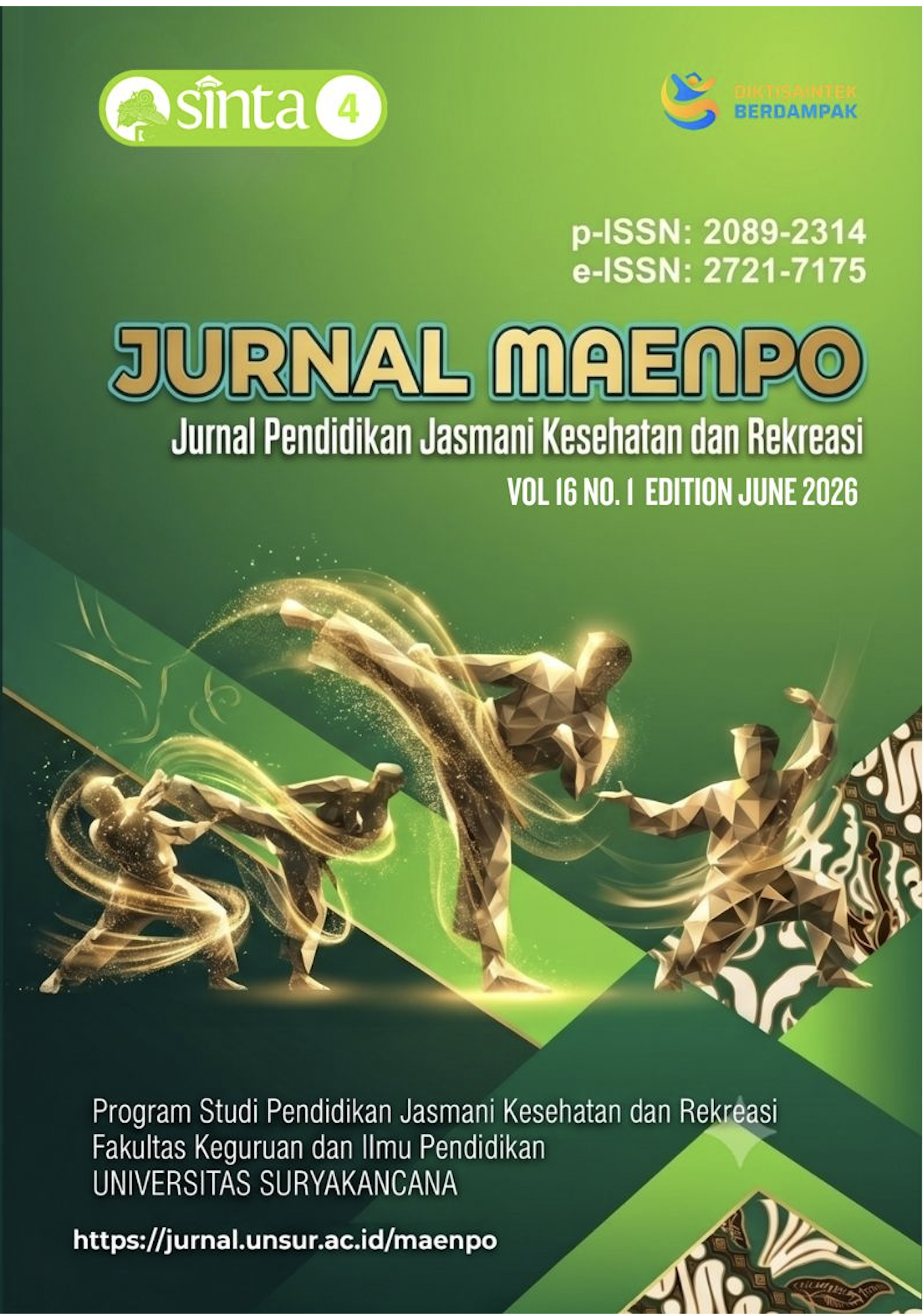
Effect of futsal student activity unit participation on physical fitness among university students
DOI:
https://doi.org/10.35194/jm.v16i1.6108Keywords:
physical fitness, futsal, student activity unit, university students, sports participationAbstract
Physical fitness plays a significant role in promoting health, enhancing productivity, and enabling students to effectively engage in their daily academic responsibilities. Nevertheless, university students often experience a decline in physical activity due to their largely sedentary routines and the growing reliance on digital technology. To counter this trend, one viable approach is to encourage student involvement in sports activities organized by student organizations, such as the Futsal Student Activity Unit (UKM). The objective of this study was to evaluate the impact of participation in the Futsal Student Activity Unit on enhancing physical fitness among students at Universitas Subang. This research utilized a quantitative methodology with a pre-experimental framework, specifically a one group pretest-posttest design. The sample consisted of 30 students who engaged actively in the futsal UKM events. Data collection involved conducting physical fitness assessments both prior to and following the training program, which included evaluations of cardiorespiratory endurance along with other fitness components. The analysis of the data was conducted using descriptive statistics and a paired sample t-test to identify any differences between the pretest and posttest outcomes. The findings demonstrated that engaging in futsal activities positively influenced the physical fitness levels of the students. Those who participated consistently in futsal training exhibited improvements in their fitness after the intervention. In summary, participating in the Futsal Student Activity Unit can effectively enhance the physical fitness of university students and serves as a valuable strategy for fostering active lifestyles within higher education settings.
References
Darisman, E. K., Maksum, A., & Priambodo, A. (2025). Membangun Mental Juara dari Rumah: Panduan Sport Parenting untuk Usia Remaja. Pena Persada Kerta Utama.
Gandrapu, A., & Rakesh, K. R. (2024). Sports Psychology: Mental Skills Training and Performance Enhancement Strategies for Athletes. Innovations in Sports Science, 1(3), 1–4. https://doi.org/10.36676/iss.v1.i3.13
Golby, J., & Wood, P. (2016). The Effects of Psychological Skills Training on Mental Toughness and Psychological Well-Being of Student-Athletes. Psychology, 07(06), 901–913. https://doi.org/10.4236/psych.2016.76092
Hariono, A., Aryanto, B., & Pahalawidi, C. (2020). Content Validity with Aiken’s V for Pencak Silat Talent Identification Test. 756–759. https://doi.org/10.5220/0009895107560759
Hughes, C., Lee, S., & Chesterfield, G. (2009). Innovation in sports coaching: the implementation of reflective cards. Reflective Practice, 10(3), 367–384. https://doi.org/10.1080/14623940903034895
Isfahani, Y. (2022). IMRPOVING STUDENTS’ MOTIVATION IN LEARNING ENGLISH USING DIGITAL PLATFORM : A LESSON STUDY IN SMK MUHAMMADIYAH BUMIAYU. Journal of Lesson Study in Teacher Education, 1(1), 45–53. https://doi.org/10.51402/jlste.v1i1.73
Kania, N., Kusumah, Y. S., Dahlan, J. A., Nurlaelah, E., Gürbüz, F., & Bonyah, E. (2024). Constructing and providing content validity evidence through the Aiken’s V index based on the experts’ judgments of the instrument to measure mathematical problem-solving skills. REID (Research and Evaluation in Education), 10(1), 64–79. https://doi.org/10.21831/reid.v10i1.71032
Kusuma Sari, O. (2021). Psychological Intervention in Community-Based Treatment of Schizophrenia: a Systematic Narrative Review. In Journal of Educational, Health and Community Psychology (Vol. 10, Number 3).
Prasetiyo, R., Bayu, W. I., & Darisman, E. K. (2022). Psychological characteristics of athletes in regional training center. Journal Sport Area, 7(2), 310–319. https://doi.org/10.25299/sportarea.2022.vol7(2).7323
Pujianto, D., Nopiyanto, Y. E., & Kardi, I. S. (2022). How is the mental toughness of student-athletes? An investigation of elite student-athletes in Bengkulu City. Journal Sport Area, 7(3), 369–379. https://doi.org/10.25299/sportarea.2022.vol7(3).9532
Putra, M. F. P., Sutoro, Sinaga, E., Hidayat, R. R., Wanena, T., Wandik, Y., Ridwan, M., Destriana, Jannah, M., Priambodo, A., Juriana, Tahki, K., Setiawan, E., & Gil-Espinosa, F. J. (2025). Impact of the Mental Toughness Training Circle on the psychological aspects of athletes in situational sports: a pilot experiment. Health, Sport, Rehabilitation, 11(3), 43–63. https://doi.org/10.58962/HSR.2025.11.3.43-63
Putra, S. P., Mandalawati, T. K., Utomo, A. A. B., Darmawan, A. D., & Prasetyo, Y. B. (2025). Pengaruh Aktivitas Fisik terhadap Kesehatan Mental: Tinjauan Pustaka dan Implikasinya terhadap Kehidupan Sehari-hari. Indonesian Journal of Physical Education and Sport Science, 5(1), 67–77. https://doi.org/10.52188/ijpess.v5i1.1087
Rintaugu, E., Mwangi, F., Andanje, N., Tian, X., Fuku, N., & Kidokoro, T. (2022). Mental Toughness Characteristics of Male University Athletes in Relation to Contextual Factors. Journal of Human Kinetics, 81(1), 243–251. https://doi.org/10.2478/hukin-2022-0019
Rose, S., & Burton, D. (2024). Exploring the impact of a mental skills training curriculum with elite university student-athletes: A qualitative case study. Journal of Physical Education and Sport, 24(11), 1564–1575. https://doi.org/10.7752/jpes.2024.11282
Roy, X., Gavrila, S. E., & Sercia, P. (2021). Reflective Practice: Helping Coaches Improve their Coaching. International Journal of Strength and Conditioning, 1(1). https://doi.org/10.47206/ijsc.v1i1.55
Safitri, R., Marcellina, S., & Abidin, Z. (2023). An Overview of Young Athlete Needs and Perceptions on Sports Psychology Services. Jurnal Pendidikan Jasmani Dan Olahraga, 8(1), 42–48. https://doi.org/10.17509/jpjo.v8i1.53666
Sutoro, Guntoro, T. S., & Putra, M. F. P. (2023). Development and validation mental training model: Mental Toughness Training Circle (MTTC). F1000Research, 12. https://doi.org/10.12688/f1000research.129010.1
Tomoliyus, T., & Sunardianta, R. (2020). Validitas Aiken’s instrumen tes untuk mengukur reaktif agility olahraga khusus tenis meja. Jurnal Keolahragaan, 8(2). https://doi.org/10.21831/jk.v8i2.32492
Vitali, F., Bortoli, L., Bertinato, L., Robazza, C., & Schena, F. (2015). Motivational climate, resilience, and burnout in youth sport. Sport Sciences for Health, 11(1), 103–108. https://doi.org/10.1007/s11332-014-0214-9
Widya Putri, M., Nuari Panggraita, G., Tresnowati, I., & Nooryana, S. (2025). Mental Training for Athletes in Achieving Maximum Performance. GANDRUNG: Jurnal Pengabdian Kepada Masyarakat, 6(1), 1853–1859. https://doi.org/10.36526/gandrung.v6i1.4209
Wu, Y., Lukosch, S., Lukosch, H., Lindeman, R. W., McKee, R. D., Fukuden, S., Ross, C., & Collins, D. (2023). Training mental imagery skills of elite athletes in virtual reality. Frontiers in Virtual Reality, 4. https://doi.org/10.3389/frvir.2023.1189717
Yuri Dias Bittencourt Nascimento, & Maria Gisele Dos Santos. (2025). Physical exercise, nutrition, and mental health: A detailed look at the psychological and physiological benefits. World Journal of Advanced Research and Reviews, 25(30), 351–360. https://doi.org/10.30574/wjarr.2025.25.3.0731
Downloads
Published
How to Cite
Issue
Section
License
Copyright (c) 2026 Arif Fajar Prasetiyo, Sopyan Rizki Haryadi, Dadan Pra Rudiana, Tini Martini

This work is licensed under a Creative Commons Attribution-ShareAlike 4.0 International License.








(1)_.png)
_.png)
1.png)